
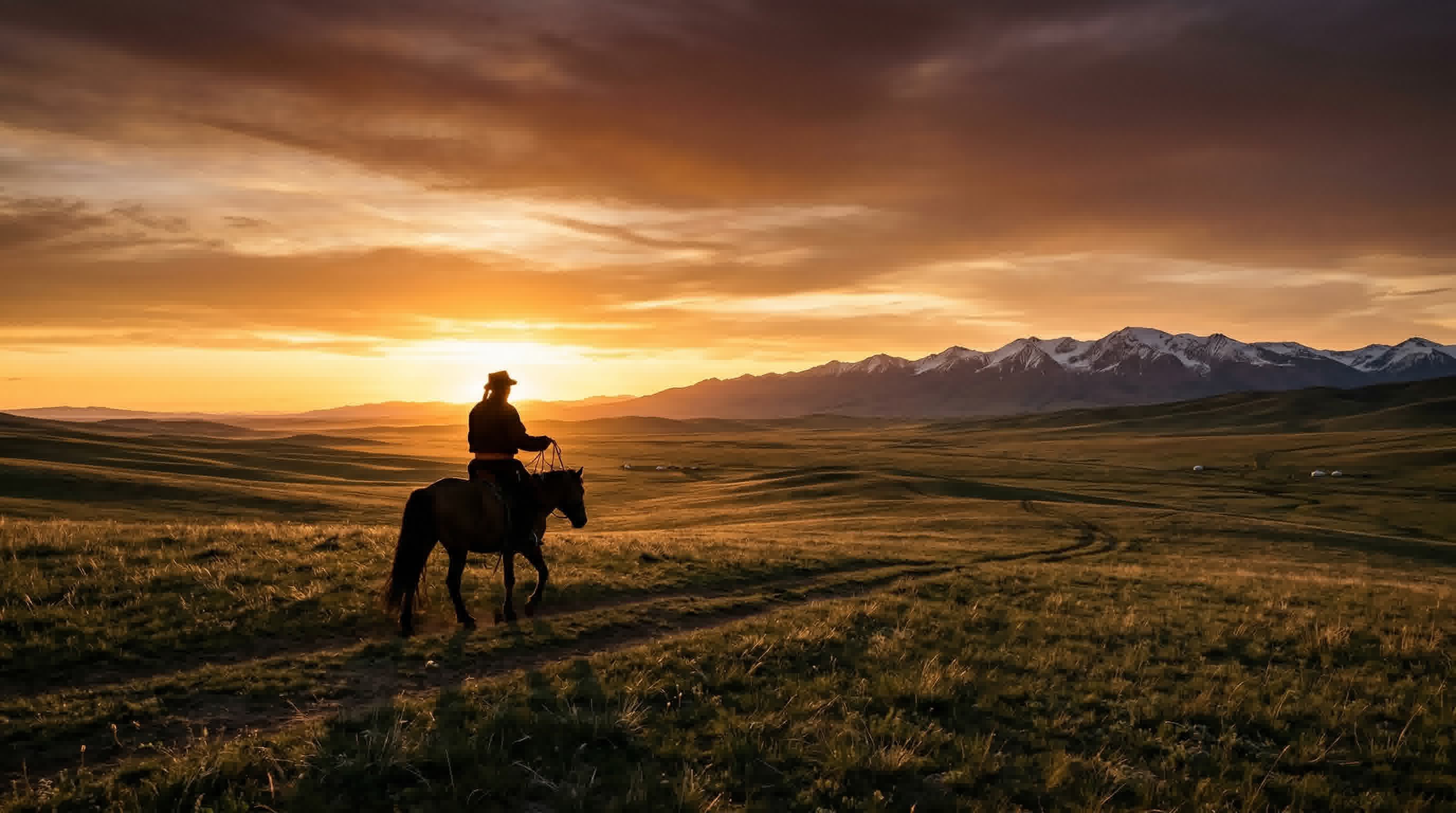
Mongolia doesn't ease you in gently. From the moment you step off the plane in Ulaanbaatar and your eyes adjust to that impossibly wide sky, you sense you've arrived somewhere genuinely different. No guardrails, no crowds, no theme-park version of wilderness — just 1.56 million square kilometers of steppe, desert, forest, and mountain waiting to be explored on its own terms.
If you're trying to figure out where to begin, these 15 incredible places to visit in Mongolia will give you a framework. Some are famous; a few are known only to those who look a little harder. All of them will stay with you long after you get home.
1. Gobi Desert
There is no single sight in Mongolia — and perhaps anywhere — quite like the Gobi at golden hour. The vast desert covers roughly one-third of the country, stretching across southern Mongolia into northern China, and it contains extraordinary variety within its 1.3 million square kilometers: towering sand dunes, dinosaur fossil beds, ice-filled canyon gorges, and sweeping saxaul forests.
First-time visitors are often surprised that the Gobi is not all sand. Most of it is gravel plain, rocky plateau, and dry steppe. But the star attractions — the Flaming Cliffs (Bayanzag), the Khongoryn Els singing dunes, and the Yol Valley ice gorge — more than live up to the legend.
Best time to visit: May through September. July and August are peak season; May and September offer cooler temperatures and fewer visitors.
How to get there: Fly from Ulaanbaatar to Dalanzadgad (approximately 1.5 hours), then hire a 4WD vehicle with driver/guide for the region.
2. Khuvsgul Lake
In the far north, cradled between the Sayan Mountains and the Siberian taiga, lies Khuvsgul Lake — a body of water so clear and impossibly blue that Mongolians call it the "Blue Pearl" and "Dalai Eej" (Mother Ocean). It's the largest freshwater lake in Mongolia by volume, 136 kilometers long and up to 262 meters deep, holding roughly 70 percent of the country's fresh water.
Surrounding the lake: larch forests, wildflower meadows, and trails that seem designed for long, unhurried walks. To the west, in the taiga, the Tsaatan reindeer herders — one of the world's last true reindeer-herding peoples — maintain a way of life unchanged for centuries.
Best time to visit: June through August for hiking and water activities; late February to early March for the spectacular Blue Pearl Ice Festival on the frozen lake.
How to get there: Fly from Ulaanbaatar to Murun (1.5 hours), then drive approximately 100 kilometers to the lakeshore village of Khatgal.
3. Gorkhi-Terelj National Park
Just 70 kilometers from Ulaanbaatar, Terelj is the easiest escape into classic Mongolian countryside — and it's spectacular. Granite rock formations including the famous Turtle Rock rise above green valleys. The Tuul River winds through the park. Ger camps dot the hillsides. In the morning light, with yaks grazing across the valley and the smell of pine in the air, it's hard to believe the capital is only an hour away.
Terelj is ideal for horseback riding, hiking, and an introduction to nomadic life. The Aryapala Meditation Temple, perched on a rocky outcrop, rewards the climb with panoramic views across the park.
Best time to visit: May through October. July sees the Naadam celebrations nearby.
How to get there: 70 kilometers northeast of Ulaanbaatar via paved road; a 1.5-hour drive.
4. Orkhon Valley
The Orkhon Valley sits at the heart of Mongolia — geographically and historically. This UNESCO World Heritage Site, located about 360 kilometers southwest of Ulaanbaatar, encompasses the ruins of Karakorum, the ancient capital of the Mongol Empire, and contains archaeological evidence spanning more than two millennia of nomadic civilization.
The valley itself is breathtaking: the Orkhon River sweeps through a wide, lush corridor flanked by basalt cliffs and rolling grassland. The Orkhon Waterfall — where the river tumbles 20 meters over a volcanic shelf — is one of Mongolia's most picturesque scenes, especially in spring and early summer. Nearby, the Tsenkher Hot Springs offer a deeply welcome soak after days on the road.
Best time to visit: June through September.
How to get there: Approximately 360 kilometers southwest of Ulaanbaatar; typically reached by 4WD as part of a Central Mongolia loop.
5. Altai Mountains
Mongolia's far west is dominated by the Altai range — a world of permanent glaciers, peaks above 4,000 meters, and ancient Kazakh culture that feels entirely separate from the rest of the country. The centerpiece is Altai Tavan Bogd National Park, home to Mongolia's highest point, Khuiten Peak (4,374 meters), and the vast Potanin Glacier stretching over 14 kilometers.
But the Altai is as much about people as it is about landscape. The Kazakh communities of Bayan-Ulgii Province have preserved their eagle hunting traditions for centuries. Watching a berkutchi (eagle hunter) work with a trained golden eagle on horseback is one of the most extraordinary things you can witness anywhere in the world.
Best time to visit: June through September for trekking; October for the Golden Eagle Festival.
How to get there: Fly from Ulaanbaatar to Ulgii (Ölgii), the regional capital (approximately 2 hours).
6. Hustai National Park
Hustai — or Khustai Nuruu — is one of Mongolia's conservation success stories. Located 100 kilometers southwest of Ulaanbaatar, the park was established in 1993 as part of an international effort to reintroduce Przewalski's horses (takhi) — the world's last truly wild horse species — back to their native steppe. Today, over 350 takhi roam the park.
The rolling mountain steppe is beautiful in its own right, home to red deer, wolves, and abundant birdlife including the cinereous vulture. Seeing the takhi at dusk or dawn, their compact dun-colored forms silhouetted against the grasslands, is genuinely moving.
Best time to visit: May through October. Dawn and dusk provide the best horse sightings.
How to get there: 100 kilometers southwest of Ulaanbaatar; a 1.5-hour drive.
7. Kharkhorin (Karakorum)
In the 13th century, Karakorum was the capital of the largest contiguous empire in history, the nerve center of a realm stretching from Korea to Eastern Europe. Today the town is small and quiet, but the nearby Erdene Zuu Monastery — Mongolia's oldest surviving monastery, built in 1586 from the ruins of Karakorum itself — is extraordinary. Its perimeter wall, punctuated by 108 white stupas, encloses three elaborately decorated temples.
The adjacent Kharkhorin Museum holds artifacts from the ancient capital, and a stone turtle guardian (one of four that once marked the city's boundaries) stands in the surrounding fields. It's a deeply atmospheric place to sit and try to imagine what once was.
Best time to visit: May through September.
How to get there: 380 kilometers southwest of Ulaanbaatar; typically reached as part of a Central Mongolia circuit or Orkhon Valley tour.
8. Bayanzag — The Flaming Cliffs
In 1922, American paleontologist Roy Chapman Andrews led an expedition into the Gobi and stumbled upon something no scientist had ever found: dinosaur eggs, fossilized in iron-red sandstone. He named the site the Flaming Cliffs — Bayanzag — after watching the sun set over the rock and cast the entire landscape in fire.
The cliffs glow most dramatically at sunrise and sunset, but they're worth visiting at any time of day. Walking the 2-kilometer rim, you can spot exposed fossil fragments in the sandstone. Over the decades, specimens of Velociraptor, Protoceratops, Oviraptor, and Pinacosaurus have been unearthed here. The site is protected, and removing fossils is illegal, but the sheer scale and color of the place make it one of the most visually striking stops in all of Mongolia.
Best time to visit: May through September. Sunset visits are essential.
How to get there: Approximately 110 kilometers from Dalanzadgad by 4WD.
9. Yol Valley (Yolyn Am)
The Gobi Desert contains ice — and that paradox is exactly what makes Yol Valley so memorable. Located within Gurvan Saikhan National Park, Yolyn Am ("Gorge of the Bearded Vulture") is a narrow canyon at 2,500 meters elevation whose shaded depths remain frozen well into summer. In June, you can wade through corridors of ice while the desert heat shimmers a few hundred meters above.
Even without the ice, the canyon is spectacular: sheer walls rise 200 meters on either side, wildlife including ibex, argali sheep, and bearded vultures inhabits the crags, and the 10-kilometer round-trip hike through the gorge is one of the best easy walks in the Gobi.
Best time to visit: May through early July for ice; the whole season (May–September) for hiking and wildlife.
How to get there: 62 kilometers northwest of Dalanzadgad by 4WD.
10. Khongoryn Els — The Singing Dunes
Mongolia's most spectacular sand dunes rise up to 300 meters from the desert floor, stretching for nearly 200 kilometers along the edge of the Altai range. When the wind moves over the crest, the dunes emit a deep, resonant hum — a sound described variously as a foghorn, a distant aircraft, or a low, ancient song. That's how they earned the name "Singing Dunes."
Climbing to the ridgeline is a serious workout in loose sand, but the view from the top — desert in one direction, mountains in the other, a nomadic family's ger camp far below — is the defining image of a Gobi journey. Camel rides with local families are available at the base.
Best time to visit: May through September. Avoid midday in July and August; temperatures can exceed 45°C in the sand.
How to get there: Approximately 170 kilometers from Dalanzadgad by 4WD.
11. Amarbayasgalant Monastery
Hidden in a remote valley in northern Mongolia's Selenge Province, Amarbayasgalant Monastery is among the finest examples of Mongolian Buddhist architecture in existence. Built in the early 18th century and modeled on the symmetry of Chinese imperial palace design, the monastery survived the communist purges of the 1930s in far better condition than most. Its original proportions, painted facades, and layered roof lines are intact and extraordinary.
Few tourists make the effort to reach Amarbayasgalant — which means fewer crowds, more authentic atmosphere, and the opportunity to witness daily monastic life alongside resident monks. The valley itself, set between forested hills and the Buren River, is peaceful and beautiful.
Best time to visit: May through September.
How to get there: Approximately 360 kilometers north of Ulaanbaatar; the last stretch requires a 4WD.
12. Gun-Galuut Nature Reserve
Just 120 kilometers east of Ulaanbaatar, Gun-Galuut is one of Mongolia's best-kept secrets — a 30,000-hectare reserve where the steppe meets wetland and where wildlife watching surpasses most places in the country. The reserve sits in the transition zone between the Eastern Steppe and the Khentii Mountains, providing habitat for argali sheep, Siberian ibex, wolves, elk, and over 200 species of birds including black storks and demoiselle cranes.
Unlike some of Mongolia's more famous parks, Gun-Galuut sees relatively few visitors, making it ideal for travelers seeking solitude, photography, and genuine wildlife encounters without the logistical complexity of a multi-week expedition.
Best time to visit: May through September; spring and early summer for migratory birds.
How to get there: 120 kilometers east of Ulaanbaatar; approximately 2.5 hours by car.
13. Tsenkher Hot Springs
After days of bumpy roads, sleeping in gers, and hiking volcanic valleys, the natural hot springs at Tsenkher feel like the best thing in the world. Located in the forested foothills of the Khangai range in central Mongolia, Tsenkher's springs reach temperatures of up to 85°C and are channeled into outdoor pools at ger camps in the area. The setting — pine trees, river valley, mountains — makes the soak all the more restorative.
Tsenkher is typically visited as part of the Central Mongolia circuit linking the Orkhon Valley, Kharkhorin, and the Khorgo Volcano.
Best time to visit: Year-round; particularly magical in winter when steam rises from hot water against a snow-covered forest.
How to get there: Approximately 420 kilometers west of Ulaanbaatar; accessible by 4WD.
14. Khorgo-Terkhiin Tsagaan Nuur (Great White Lake)
The Great White Lake sits in the crater landscape of central Mongolia's Khangai volcanic zone, surrounded by the remnants of ancient lava flows and the perfectly conical Khorgo Volcano. The lake itself is deep, freshwater, and startlingly clear — a turquoise bowl set against dark basalt and green forest. Hiking up Khorgo Volcano takes about an hour and reveals views across the lake and the surrounding volcanic plateau.
This is one of Mongolia's most beautiful and undervisited landscapes, offering camping, fishing, and total solitude.
Best time to visit: June through September.
How to get there: Approximately 680 kilometers west of Ulaanbaatar by 4WD; often reached via Tsetserleg or Tsenkher.
15. Elsen Tasarkhai (Mini Gobi)
If you can't make it all the way to the Gobi Desert, Elsen Tasarkhai offers a taste of dune country just 280 kilometers west of Ulaanbaatar. This narrow corridor of sand dunes — rising 30 to 80 meters and stretching about 80 kilometers — cuts unexpectedly through open steppe, creating a dramatic visual contrast. Camel riding is available, and the dunes glow beautifully at sunrise and sunset.
The nearby Khogno Khan Mountain, with its ruined monastery and rocky trails, makes Elsen Tasarkhai an ideal stop on the route between Ulaanbaatar and the Orkhon Valley.
Best time to visit: April through October.
How to get there: 280 kilometers west of Ulaanbaatar; 3 to 4 hours by paved and unpaved road.
How to See More of Mongolia
These 15 places represent the range of what Mongolia offers — but they barely scratch the surface of the country's 1.56 million square kilometers. The best journeys here combine several regions: a few days in Ulaanbaatar, the Gobi Desert, and then the north or west depending on your interests and time.
Most travelers find that having a knowledgeable guide makes the difference between a good trip and an extraordinary one. Roads are unmarked, distances are vast, and local knowledge — knowing which family camp to visit, which valley holds wildlife at this time of year — is invaluable.
Planning a journey through these incredible places to visit in Mongolia? Unveil Mongolia offers expertly curated tours across all of these regions, with deep local knowledge and flexible itineraries built around what matters most to you.