
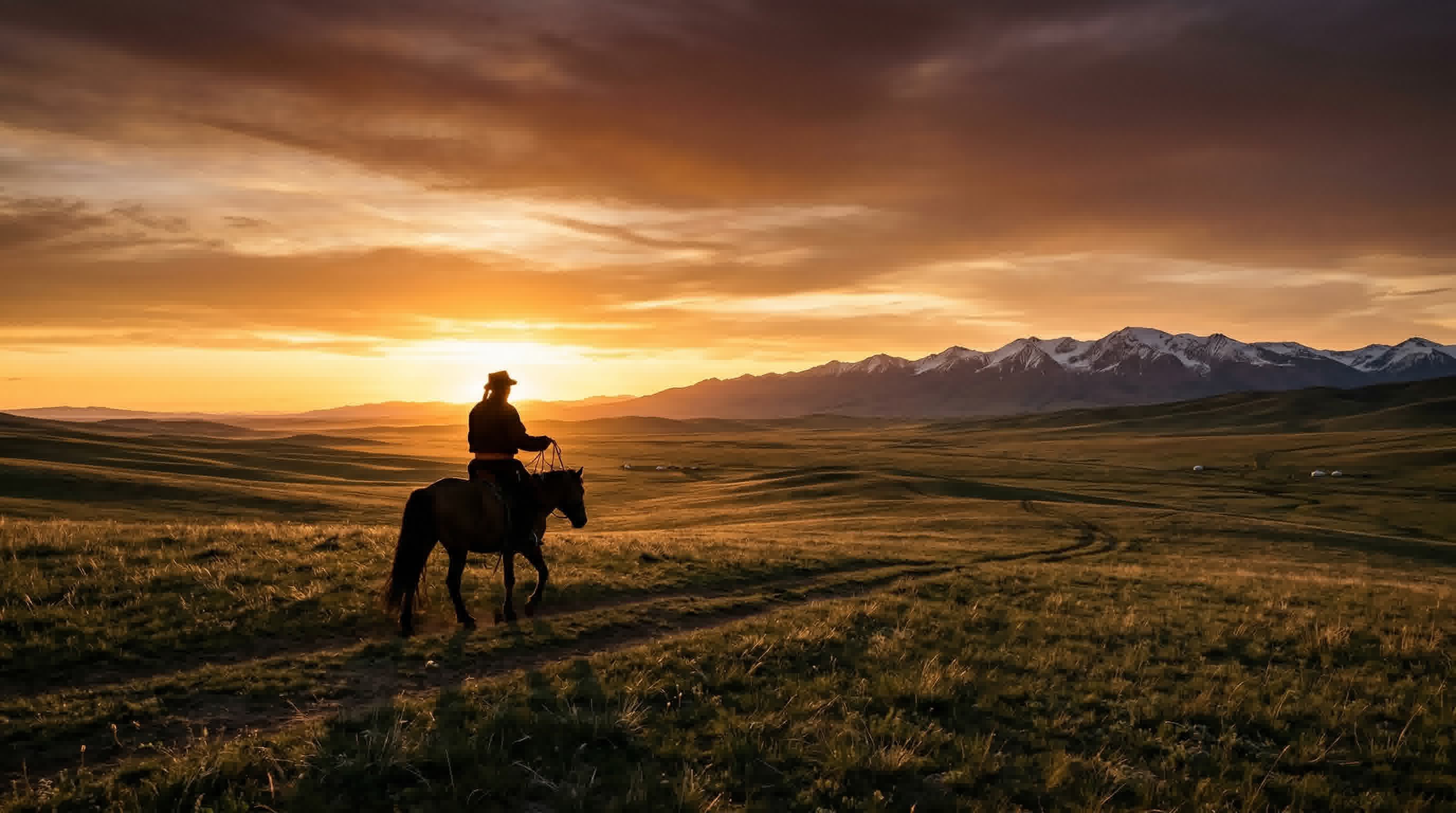
There are places in Mongolia that feel like they belong to a different century — or perhaps to no century at all, only to themselves. The Altai Mountains of western Mongolia are one of those places.
Here, in the remote province of Bayan-Ulgii, the Altai range rises to over 4,000 meters. Permanent glaciers descend from peaks that straddle the borders of Mongolia, Russia, China, and Kazakhstan. Ancient petroglyphs cover cliff faces along river valleys. And Kazakh nomads — descendants of kok-turk central Asian herdsmen — still hunt from horseback with trained golden eagles, as they have for centuries.
The Altai Mountains Mongolia region is one of the world's great adventure travel destinations: physically demanding, culturally extraordinary, and still relatively unknown compared to the Gobi Desert or Khuvsgul Lake. If you're willing to make the effort to get here, the Altai will pay you back in ways that are difficult to describe and impossible to forget.
Geography of the Mongolian Altai
The Mongolian Altai is part of the broader Altai mountain system that extends through Russia, Kazakhstan, China, and Mongolia. In western Mongolia, the range reaches its highest expression in the Tavan Bogd ("Five Saints") Massif, a cluster of five peaks straddling the borders of Mongolia, Russia, and China.
Key geographic facts:
- Mongolia's highest point: Khuiten Peak, 4,374 meters
- Largest glacier: Potanin Glacier, approximately 14 kilometers long
- Main park: Altai Tavan Bogd National Park
- Provincial capital: Ulgii (Ölgii)
- Dominant ethnic group: Kazakhs (approximately 93% of Bayan-Ulgii Province)
The landscape shifts dramatically within the region: from high glaciated peaks to stunning alpine lakes at 2,000 meters elevation, from lush river valleys to desert-like plains in the lowlands. The Baga Turgen Valley, where the mountains soften into rolling foothills, has been nicknamed "the Switzerland of Mongolia" — a comparator that sells the Altai short, but gives a sense of its alpine character.
The Kazakh Eagle Hunters
No aspect of the Altai region is more famous — or more genuinely extraordinary — than the Kazakh tradition of hunting with golden eagles on horseback. The practice, known as berkutchi (the eagle hunters are berkutchi), dates back at least to the time of Genghis Khan and is depicted in cave paintings from the Bronze Age. Marco Polo documented it in the court of Khubilai Khan in the 13th century.
Today, approximately 240 Kazakh berkutchi practice the art in Bayan-Ulgii Province. The tradition is typically passed from father to child, and requires years of training for both hunter and eagle. Berkutchi use female golden eagles exclusively — females are larger, more aggressive, and more powerful hunters. The birds have wingspans of up to 2 meters and can weigh over 6 kilograms.
The hunting itself is carried out in winter, when fox, hare, and occasionally wolf are pursued across snow-covered valleys. A berkutchi rides at full gallop across the steppe with the eagle on his arm; when prey is spotted, the eagle is released to stoop and strike. The bond between hunter and eagle — built through years of shared living; the eagles often sleep inside the family ger — is one of the most unusual human-animal relationships on Earth.
Experiencing eagle hunters as a visitor: Several Kazakh families in the Sagsai soum area and around Ulgii town are accustomed to welcoming visitors. You can arrange through local tour operators to visit an eagle hunter's home, meet the eagle, observe training demonstrations, and even hold the bird on your arm. Genuine hunting trips (in winter) are available for visitors who want a deeper experience. Be respectful: these are working families, not performers, and treating the encounter with genuine curiosity and respect makes a real difference.
The Golden Eagle Festival
Each year in early October, the largest gathering of eagle hunters and their eagles in the world takes place in the fields outside Ulgii. The Golden Eagle Festival was established in 1999 to preserve and celebrate this cultural heritage, and it has been recognized as a UNESCO World Heritage Cultural Event since 2011.
Up to 80 eagle hunters participate in the main October festival; two smaller September festivals (typically held on the second and third weekends of September) attract around 40 hunters each.
What happens at the festival:
- Opening parade of mounted hunters in traditional dress, each with a blindfolded eagle on their arm
- Eagles released from a hillside, commanded to return to their trainer's arm from a distance
- Eagle speed trials: birds released to stoop on a fox-skin dragged behind a galloping horse
- Judges score hunters on the bond and communication between hunter and eagle, the beauty of the hunter's traditional clothing, and the ornamentation of the horse
- Kazakh games played on horseback: kukbar (goatskin tug-of-war), tiyn teru (coin pickup from galloping horse), kyz kuar (women and men horseback chase)
- Evening concerts of traditional Kazakh music and throat singing in Ulgii town
Practical details:
- The October festival is the main event; it's larger, more photographically spectacular, and more competitive
- Book accommodation and tours well in advance — domestic flights to Ulgii have limited capacity and fill quickly
- 2026 festival dates: September 17–18 (first smaller festival), October 3–4 (main festival)
- Tours from Ulaanbaatar for the festival with guide, transport, and accommodation cost approximately $1,800–3,100 USD per person for 8–10 days
Altai Tavan Bogd National Park
The crown jewel of western Mongolia is Altai Tavan Bogd National Park — a high-altitude wilderness of glaciers, alpine lakes, river valleys, and bronze-age rock art. The park is named after the five sacred peaks (tavan bogd = "five saints") of the Tavan Bogd Massif, which forms part of the border with Russia and China.
Key Highlights Within the Park
Khuiten Peak (4,374 m) Mongolia's highest mountain. A technical mountaineering route, not a casual hike — you'll need crampons, ice axe, and experience with glaciated terrain (or a guide). Summit attempts typically take 2–3 days from base camp. The sense of achievement, and the views across three countries, are extraordinary.
Potanin Glacier The largest glacier in Mongolia, stretching approximately 14 kilometers from the base of the Tavan Bogd peaks. Accessible on a full-day trek from base camp, the glacier is a dramatic and humbling sight — deep crevasses, ice towers, and the sound of meltwater running in hidden channels. Climate change is visibly affecting the glacier's margins; researchers have documented significant retreat in recent decades.
Khoton and Khurgan Lakes Two pristine twin lakes connected by a narrow channel at 2,000 meters elevation, surrounded by snow-capped peaks. Crystal clear, cold, and strikingly beautiful — ideal for camping and photography. The area around these lakes is also home to brown bears, ibex, and abundant birdlife.
Dayan Lake The access route to Tavan Bogd passes along Dayan Lake, where forest meets open steppe and the landscape is ideal for spotting migratory birds. Bronze Age deer stones and Turkic period human-shaped stones (dating from the 6th to 8th century AD) stand along the valley, providing an extraordinary layering of history over landscape.
Petroglyphs of the Altai
The Altai region contains some of Mongolia's most significant concentrations of prehistoric rock art. The petroglyphs of the Tsagaan Salaa and Baga Oigor Rivers — a UNESCO World Heritage Site — include over 10,000 images carved into cliff faces over a span of approximately 12,000 years: hunting scenes, animals, shamanistic figures, and depictions of the changing culture of the steppe.
Standing before a cliff covered in figures carved 3,000 years ago by people who stood in the same valley looking at the same mountains produces a particular kind of time-travel vertigo that stays with you.
Adventure Activities in the Altai Mountains
Trekking and Hiking
The Altai offers some of the best high-altitude trekking in Central Asia. Popular routes include:
- Tavan Bogd Base Camp Trek: 3–5 days round trip from the park entrance at Dayan Lake; passes through stunning glacier scenery and reaches the base of the highest peaks
- White River Valley Trek: A multi-day journey through the valley between Tavan Bogd and Khoton Lake; spectacular views and abundant wildlife
- Potanin Glacier Day Hike: A challenging full-day return hike from base camp
Most trekking requires a local guide, especially for routes near glaciers and high-altitude passes. The terrain is remote and rescue services are minimal — preparation and experience matter.
Mountaineering
For experienced mountaineers, the Tavan Bogd Massif offers serious climbing objectives. Khuiten Peak (4,374 m) is the main goal, requiring glacier travel, fixed rope sections, and acclimatization. Best climbing window: July to early September.
Permits are required from the park authority for high-altitude climbing and glacier access.
Horseback Riding
The Altai is superb horse country — vast valleys, ancient herding routes, and Kazakh families who are among the finest horsemen in the world. Multi-day horseback trips into the park interior are available through local operators. Expect to ride 4–8 hours per day on well-conditioned local horses.
Prices: approximately $30–60 USD per horse per day, plus guide fees.
River Rafting
Several rivers flowing from the Altai range are suitable for rafting, particularly during the spring melt when water levels are high. The Khovd River and tributaries offer Class II–IV whitewater depending on season and section.
Cultural Experiences with Kazakh Communities
Beyond the eagle hunters, the Kazakh communities of Bayan-Ulgii offer rich cultural encounters for travelers willing to engage genuinely. The Kazakhs of Mongolia have preserved their language, music, crafts, and semi-nomadic traditions to a remarkable degree — in large part because their remoteness from Ulaanbaatar insulated them from the homogenizing pressures of the 20th century.
What to experience:
- Home visits: Spending time in a Kazakh family's ger (taller and more spacious than a Mongolian ger) over tea, flatbread, and conversation is one of the most hospitable experiences Mongolia offers
- Dombra music: The Kazakh long-neck lute; skilled players are common in the communities and will often play for guests
- Traditional handicrafts: Intricate felt carpets (shirdak), embroidered wall hangings (tuskiiz), and eagle handler's accessories — including the leather arm hoods (tomaga) for the birds — are among the finest craft traditions in the region
- Cuisine: Beshbarmak (boiled meat on flat noodles), samsa (baked pastries), and kurt (dried yogurt balls) are the staples; sharing a meal is a central act of Kazakh hospitality
Permits
Altai Tavan Bogd National Park entrance fee: Approximately $3–5 USD per day
Photography permit: Nominal fee at the park entrance
Mountaineering/glacier permit: Required for Khuiten Peak and Potanin Glacier access; arrange through your tour operator before arrival
Border zone permits: Parts of the park near the Chinese and Russian borders require additional permit documentation. Your tour operator will handle this.
Best Time to Visit the Altai Mountains
| Season | Conditions | Best For |
|---|---|---|
| June–early September | Warm days (15–25°C), accessible roads, rivers fordable | Trekking, mountaineering, horseback riding, cultural visits |
| Late September–October | Stunning autumn colors, cooler temperatures, fewer travelers | Golden Eagle Festival, photography, cultural festivals |
| November–May | Harsh winter, deep snow on mountain roads, extreme cold | Winter photography, eagle hunting season (experienced travelers only) |
Most visitors choose June–September for comfort and maximum access. October is increasingly popular for the eagle festival combined with autumn landscape photography.
How to Get to the Altai Mountains
Step 1: Fly to Ulgii (Ölgii)
Ulgii is the capital of Bayan-Ulgii Province and the main gateway for western Mongolia. MIAT Mongolian Airlines and Aero Mongolia operate flights from Ulaanbaatar to Ulgii approximately 3–4 times per week. Flight time is approximately 2 hours. Tickets cost around $120–200 USD each way; book well in advance for October festival period.
Step 2: Ulgii to the National Park
Ulgii town to the entrance of Altai Tavan Bogd National Park (Dayan Lake) is approximately 200 kilometers by 4WD road — a 5–8 hour journey depending on road conditions. There is no public transport; arrange your vehicle through your tour operator in advance.
The drive itself is part of the experience: mountain valleys, Kazakh herder camps, rivers to ford, and occasional traditional wrestling contests you'll stumble upon unexpectedly.
Where to Stay
In Ulgii town: Several small hotels and guesthouses accommodate visitors before and after park visits. The Eagle's Nest (run by Altai Expeditions) and basic family guesthouses offer comfortable stays from $25–60 USD per night.
In the national park: Camping is the standard accommodation. Some operators set up dedicated ger camps near the main trekking routes. Wild camping is also permitted. Bring a four-season tent and sleeping bag rated to at least -10°C even in summer.
With Kazakh families: The most authentic (and most memorable) accommodation option. Several families along the route to Tavan Bogd host overnight guests in their gers. Your guide will arrange this.
Ready to Plan Your Altai Mountains Adventure?
The Altai Mountains of Mongolia represent an increasingly rare kind of travel: genuinely remote, deeply cultural, physically demanding, and utterly spectacular. Whether you're drawn by the eagle hunters, the glaciers of Tavan Bogd, or the sheer beauty of a landscape that has changed little in a thousand years, the Altai delivers at every turn.
Unveil Mongolia offers custom Altai Mountains tours combining the Golden Eagle Festival, Tavan Bogd National Park trekking, and immersive stays with Kazakh families. Their experienced local guides and deep knowledge of western Mongolia make the difference between a great adventure and a truly extraordinary one.