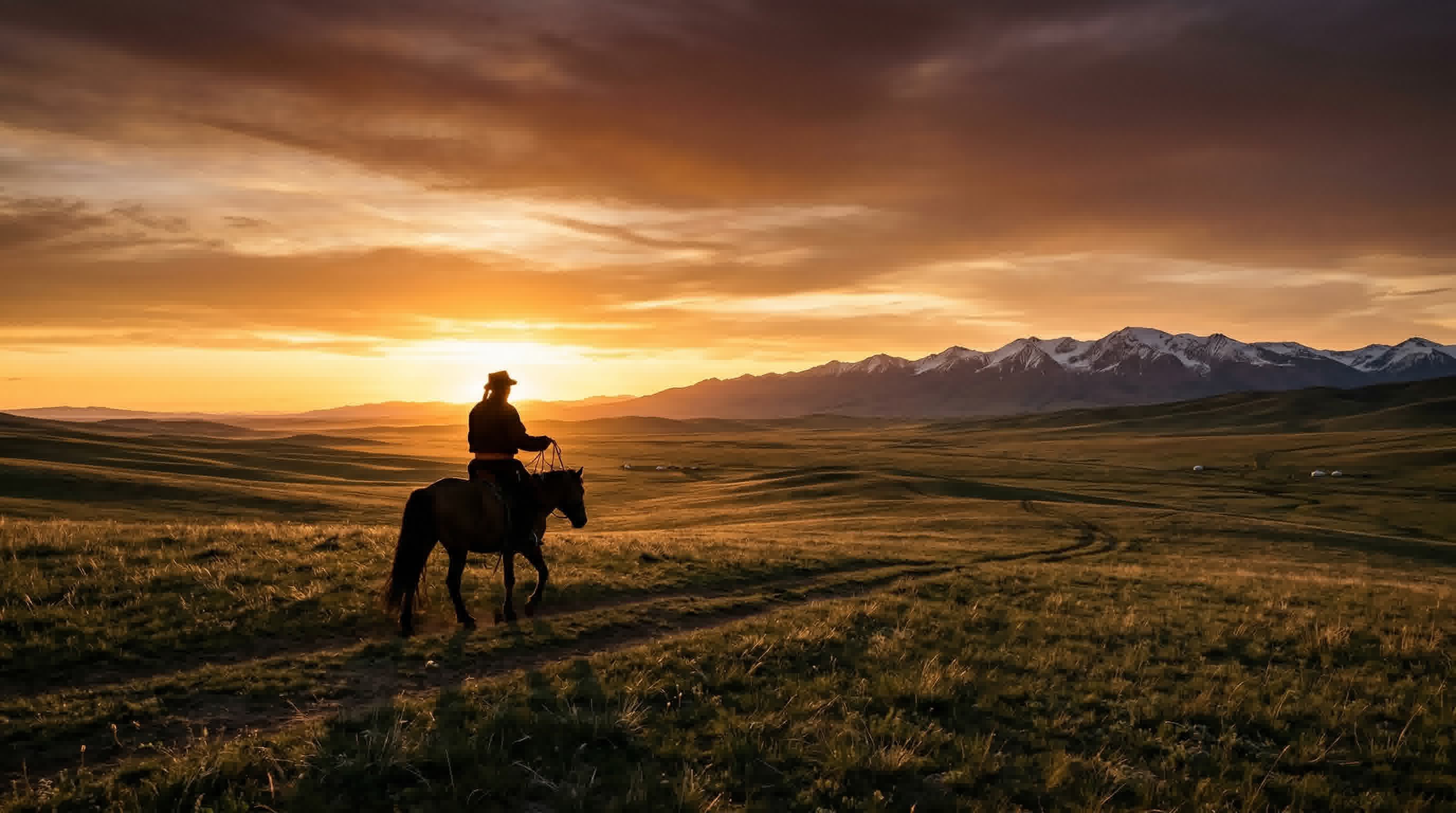
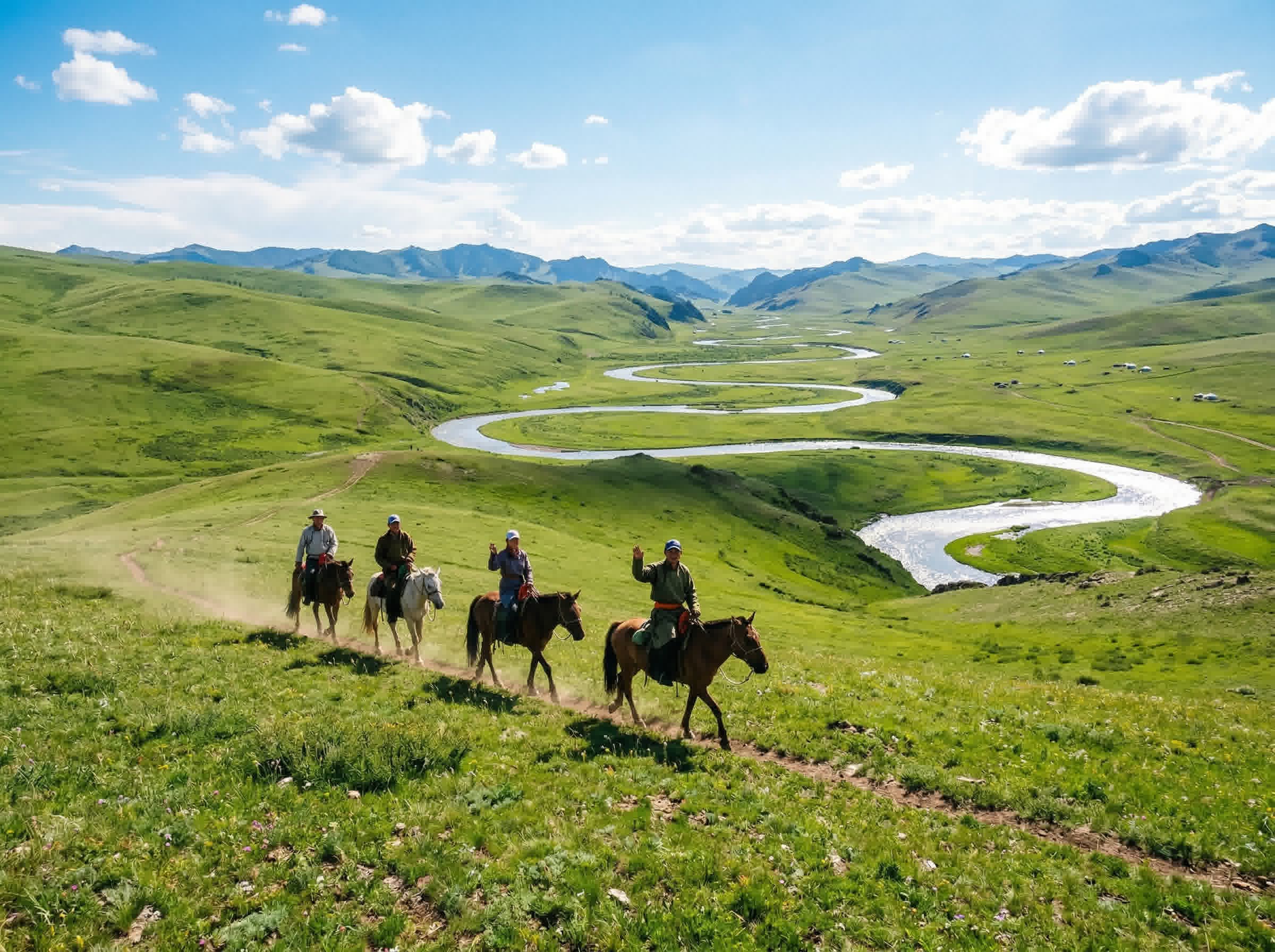
The hunter rides out of the morning mist on horseback, a golden eagle perched on his arm. The bird is enormous — wingspan exceeding two meters, talons the size of a man's hand, amber eyes scanning the landscape with ancient patience. On command, she launches from the fist, climbs steeply, then locks her wings into a dive that brings her down at 150 kilometers per hour to land, in a thunder of feathers, exactly where the hunter called her.
This is eagle hunting. And in the far west of Mongolia, in the Altai Mountains of Bayan-Ölgii Province, it has been practiced by the Kazakh people for over a thousand years.
Every year in autumn, the world's eagle hunters gather for the Golden Eagle Festival near Ölgii town — two days of competitions, traditional games, horsemanship, music, and color that constitute one of the most extraordinary cultural events anywhere on earth. If there is a single festival in Mongolia that rivals Naadam for sheer visual spectacle and emotional impact, this is it.
Here is your complete guide.
The History of Kazakh Eagle Hunting
The art of hunting with golden eagles — called berkutchi in Kazakh — has been practiced across the Eurasian steppe for at least three thousand years, with some archaeological evidence suggesting its roots go back even further. Historical accounts describe Genghis Khan himself keeping over 1,000 hunting birds. Marco Polo documented eagle hunting in the Mongol Empire during his travels in the 13th century.
Among the Kazakhs of western Mongolia, the tradition survived the Soviet era's disruptions to nomadic life largely because Bayan-Ölgii Province remained relatively isolated and because the practice was so deeply woven into family identity and herding culture that it endured informally even when officially discouraged.
Today, approximately 250 active eagle hunters practice the art in Bayan-Ölgii. The knowledge is passed from father to son — occasionally father to daughter, with a small number of female eagle hunters now competing at festivals and gaining international attention. Hunters typically spend years learning from a parent or elder, beginning by observing before ever holding a bird, then progressing through years of practice before hunting independently.
UNESCO recognition: In 2011, the traditional knowledge and skills related to eagle hunting in Kazakhstan — and by cultural extension to the closely related Mongolian Kazakh practice — was recognized by UNESCO as a living heritage tradition. The Golden Eagle Festival itself was founded in 1999 specifically to preserve and promote this heritage in the face of modernization and rural-to-urban migration.
The Golden Eagle: The Hunter's Partner
The bird of choice is the golden eagle (Aquila chrysaetos), one of the most powerful birds of prey on earth. Adult females — used almost exclusively for hunting, as they are significantly larger and more powerful than males — can weigh up to 7 kilograms with a wingspan of up to 2.3 meters.
Eagles are captured as juveniles (usually one to two years old) from nests in the Altai mountain cliffs, trained over months and years, and hunted actively for seven to ten years before being released back to the wild to breed. This cycle is both practical and culturally mandated: keeping an eagle beyond its prime is considered disrespectful. The relationship between hunter and eagle is understood as a partnership, not ownership.
Training: Training a hunting eagle is a years-long process. The bird is first habituated to the hunter's presence through constant physical contact — hunters sleep with their eagles on their arms in the early stages. The eagle is then trained to fly to the fist for food, then to fly to the fist from distance, and eventually to pursue and catch prey. Training sessions happen daily during the first years. A well-trained eagle will respond to the hunter's call from hundreds of meters away.
The most prized hunting situation is pursuing foxes across the winter steppe — the fox's thick winter fur is the primary reason eagles are used, as the birds can locate and chase foxes across snow where dogs and horses would struggle.
What Happens at the Golden Eagle Festival
The Golden Eagle Festival takes place near Ölgii town on the open steppe, approximately 7–14 kilometers from the town center. The festival ground is a wide valley backed by the snowy peaks of the Altai Mountains — a natural amphitheater that makes every photograph extraordinary.
The two-day festival is organized by the Mongolian Eagle Hunters' Association and draws around 100 eagle hunters from villages across Bayan-Ölgii Province. Around half the hunters are well-known to spectators; some have become internationally famous through documentary films and travel photography.
Day One: The Opening Parade
The festival opens with a parade of eagle hunters on horseback — one of the most spectacular sights in Central Asian cultural tourism. Hunters wear full traditional Kazakh dress: fox-fur hats, embroidered robes, leather gauntlets, and elaborately decorated saddles. Their eagles ride on the fist, hooded with painted leather hoods. The parade moves through the festival ground as hundreds of spectators photograph from both sides.
The Competitions
The core competitions test the central skills of eagle hunting:
Speed and accuracy from height: Hunters ride their horses to a high point on the surrounding ridge. The eagle is launched. The hunter rides down the slope calling the eagle, which must locate its hunter and land on the fist within a set time. Eagles are scored on speed, accuracy, and the quality of the hunter-eagle communication.
Eagle descent to the lure: A piece of fox fur (the lure) is dragged behind a galloping horse. The eagle, released from height, must stoop and strike the lure accurately. This competition most closely simulates actual hunting behavior.
Tazi (Kazakh sighthound) competitions: Kazakh hunters often work with both eagles and tazi dogs — a slender sighthound similar to a greyhound. Some festivals include tazi racing or hunting demonstrations alongside the eagle events.
Traditional horse games: Competitions in tiyin teru (picking coins from the ground at full gallop) and kökbörü (a game involving a goat carcass and two teams on horseback, similar to polo) add to the festival program and showcase the extraordinary horsemanship of the Kazakh nomads.
Evening cultural program: On both evenings of the festival, the Ölgii Cultural Center hosts performances of traditional Kazakh music, dance, and the dombra (a two-stringed instrument central to Kazakh musical culture).
2026 Festival Dates
The Golden Eagle Festival in Mongolia runs on a regular autumn schedule. For 2026:
- Altai Nomads Game (Altai village): September 12–13, 2026
- Sagsai Golden Eagle Festival: September 17–18, 2026
- Main Golden Eagle Festival (Ölgii town): October 3–4, 2026
The main October festival, organized by the Mongolian Eagle Hunters' Association, is the largest and most internationally recognized. The September festivals in Altai and Sagsai are smaller, more intimate, and equally worthwhile — if your schedule allows, attending both the September Sagsai festival and the October main event gives an extraordinary two-part experience.
There is also a Winter Eagle Festival held in February (dates vary by year) near Ölgii. This is a completely different experience: snow-covered Altai Mountains, hunters in heavy fur coats, and the possibility of witnessing real hunting rather than festival demonstrations. Temperatures can drop to -20°C or below, and the logistics are more demanding, but visitors who attend consistently describe it as the most atmospheric and authentic eagle hunting experience available.
How to Get to Ölgii
Bayan-Ölgii Province is in the far western corner of Mongolia, approximately 1,700 km from Ulaanbaatar. Getting there requires either a domestic flight or a very long overland journey.
By Air (Recommended)
MIAT Airlines operates direct flights from Ulaanbaatar (Chinggis Khaan International Airport) to Ölgii Airport. In 2025, flights operated three times per week (Mondays, Wednesdays, and Saturdays). Flight time is approximately 2 hours. The 2026 schedule is expected to follow the same pattern.
Critical: Flights to Ölgii sell out months in advance for the festival period. In previous years, flights were booked solid 5–6 months before the October festival. Book as early as possible — this is not an exaggeration.
Return flights are equally critical to book early. Do not arrive in Ölgii without a confirmed return flight.
By Road
The overland route from Ulaanbaatar to Ölgii covers approximately 1,700 km and takes 3–4 days by 4WD vehicle. This is only practical for travelers with significant time and a high tolerance for rough, remote roads — much of the route is unpaved. Some specialist operators offer overland tours that incorporate the drive as part of the experience.
Getting Around in Ölgii
Ölgii is a small town and easy to navigate. The festival venue is a 20–30 minute drive from town. Most tour operators arrange transport to the festival site. Taxis are available in town but scarce during festival days — arrange transport through your accommodation or operator.
Where to Stay in Ölgii
Accommodation in Ölgii is limited and fills completely during the festival period. Options include:
Hotels in Ölgii town: Several small hotels operate in town, ranging from basic guesthouses ($15–25/night) to slightly more comfortable mid-range options ($40–70/night). Book months in advance.
Nomadic family stays: The most atmospheric option — staying with a Kazakh eagle hunting family in their ger camp before or after the festival. Many tour operators arrange this as part of their festival packages. A home stay with an eagle hunter family gives you access to the birds themselves, one-on-one conversations (through your guide/interpreter) about training and hunting, and an insight into Kazakh nomadic life that no hotel can replicate.
Ger camps near the festival site: Some operators set up temporary ger camps near the festival ground for the event period. These are popular with photography tour groups and sell out very early.
Cost for accommodation: Expect to pay a significant premium during festival week. Factor in 2–3x normal rates.
Meeting the Eagle Hunters
The festival provides an extraordinary access that would be remarkable anywhere: the hunters are approachable, their eagles can be photographed (and sometimes held, for a small fee), and with a guide or interpreter, genuine conversations are possible.
Some hunters have become internationally known. Aigerim Serikbayeva is one of Mongolia's prominent female eagle hunters; Jenisbek Tserikbayev has been described as Mongolia's most famous eagle hunter and was a subject of major international media coverage. Meeting hunters like these — and the dozens of others at the festival — is not staged celebrity access. It is an encounter with people who practice a living tradition and are proud to share it.
Photography etiquette: Always ask before photographing individual hunters. Most are happy to pose with their birds for a modest payment (typically $2–5). Do not approach eagles from behind or attempt to touch them without permission from the hunter. Eagles are working animals that have formed a specific bond with one person — they can be unpredictable with strangers.
Photography Tips for the Eagle Festival
The Golden Eagle Festival is one of the most photographed cultural events in Asia, and for good reason. Here's how to make the most of it:
Gear: A telephoto zoom lens (70–200mm at minimum; 100–400mm for the flight competitions) is essential. Wide-angle shots work beautifully for the opening parade and the festival crowd atmosphere. Bring more memory cards than you think you need.
Position yourself for the speed competitions: The hilltop release and stoop-to-fist competitions happen with the eagle flying from distance. Position yourself near the hunter's arrival point (at the base of the slope) for the most dramatic shots of the eagle's final descent.
Use the morning light: Both festival days start with the parade in the morning. The light in the Altai Mountains in early October is extraordinary — golden, directional, and perfect for portraits of hunters with their birds.
The parade: Find a position along the parade route with an unobstructed sightline. The parade is slow enough that you have time to photograph multiple hunters as they pass.
Experiment with burst mode for the flight competitions — the eagle's stoop is extremely fast and unpredictable in its final trajectory.
Cold weather: October temperatures in Ölgii range from 5°C to -10°C during the day. Battery performance drops in cold weather — keep spare batteries in an inner pocket against your body.
Costs
- Festival entry: $50–60 per person per day
- Domestic flights (UB to Ölgii, return): $200–350 depending on availability
- Accommodation in Ölgii (festival week): $30–80/night (book early)
- Nomadic family stay: $20–40/night with meals, or included in a tour package
- Guided 9-day festival tour (all inclusive): approximately $2,400–3,650 per person
- Photographer with eagle (posed shot): $2–5
The Winter Eagle Festival: A Quieter Alternative
For travelers who cannot attend in October or who want a more remote, atmospheric experience, the Winter Eagle Festival in February near Ölgii offers a completely different dimension. Snow covers the Altai Mountains. Hunters wear enormous fur coats and hats. The cold is serious — dress accordingly — but the light, the drama of the snow-covered landscape, and the smaller crowds create images and memories of a different quality.
Real hunting is more likely to occur in winter (this is the actual hunting season, after all), and some operators can arrange dedicated winter hunting experiences where you accompany a hunter family out onto the steppe for an actual fox hunt. These are extraordinary encounters that go far beyond festival tourism.
Practical: February in Ölgii requires serious cold-weather gear (-20°C temperatures are possible), advance planning, and a specialist operator. Flights still apply. The logistics are harder, but the rewards for those who make the journey are extraordinary.
Cultural Significance and the Future of Eagle Hunting
Eagle hunting faces the same pressures as many traditional practices: young people migrating to cities, the economics of nomadic herding becoming more difficult, and the years of patience required to train an eagle competing against faster, more immediate entertainments.
The Golden Eagle Festival was designed in part to address this. By creating an international audience for the tradition, it has generated economic value for eagle hunters and created a cultural pride that helps keep young Kazakhs engaged with their heritage. The festival has grown substantially since its founding in 1999 and now attracts significant international media and tourism, all of which creates livelihood for the hunters and their families.
Traveling to the festival with a responsible operator — one who works directly with hunter families, keeps tourism from overwhelming the festival atmosphere, and channels money to the communities involved — is the best way to support the tradition you've come to witness.
There are perhaps 250 active eagle hunters in the world. They live in a remote mountain province at the edge of Mongolia and Russia, they practice a skill passed down through 3,000 years of steppe culture, and every October they gather to compete and celebrate. Go and see them.
Planning your trip to the Golden Eagle Festival? Unveil Mongolia offers customized western Mongolia tours that combine the festival with visits to Altai Tavan Bogd National Park, nomadic Kazakh family stays, and connections to experienced local guides. Get in touch to plan your festival journey.