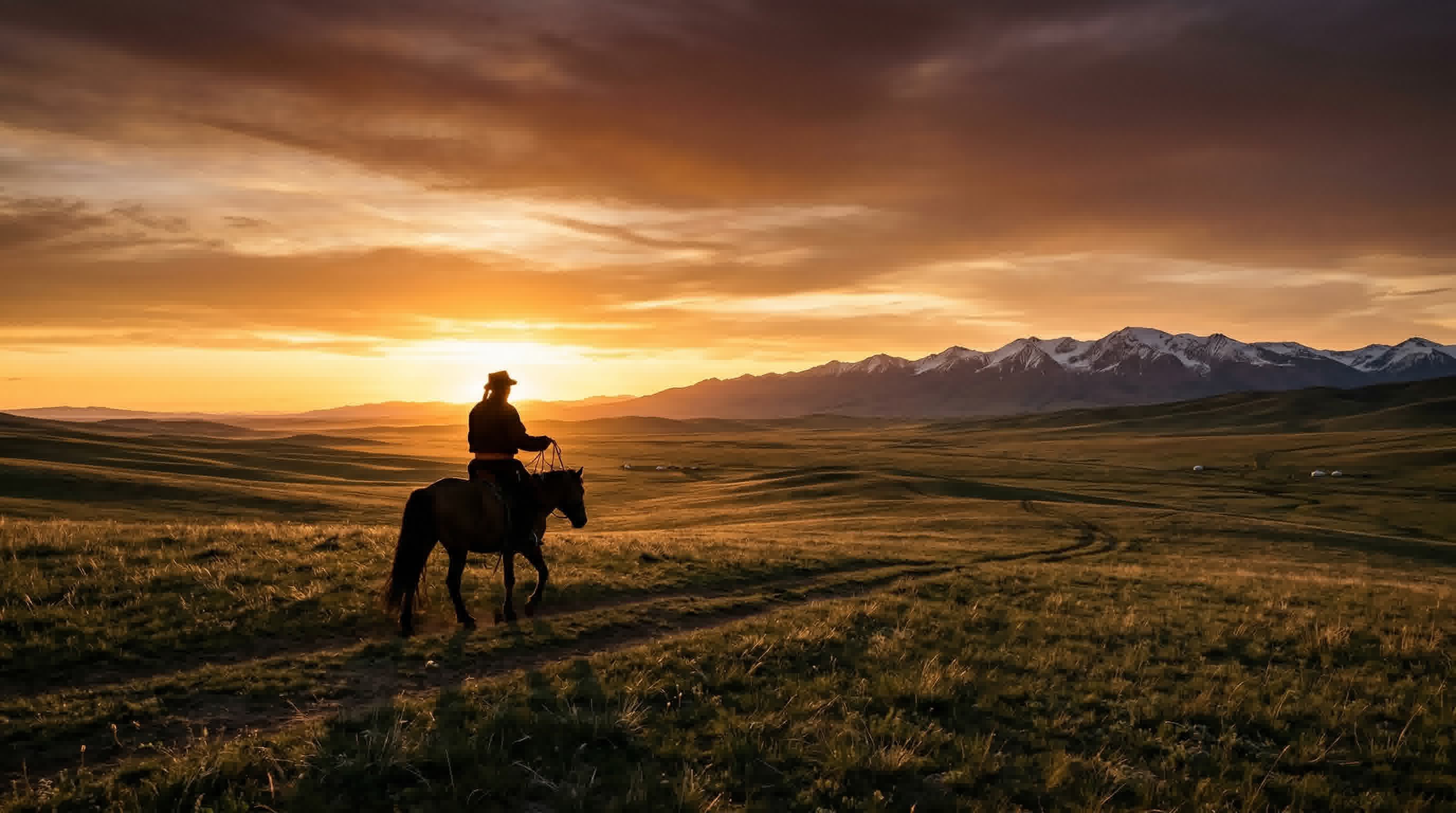
You've seen the photographs: a round white tent on a vast green plain, smoke curling from a pipe in the domed roof, a horse tied nearby and mountains in the distance. The image is so iconic that it risks becoming a cliché — until you step through that small painted door yourself, lower yourself onto one of the beds arranged around the curved walls, accept a bowl of suutei tsai (warm, salty milk tea) from your host, and understand, for the first time, that home really can be anywhere.
A stay in a ger in Mongolia is not simply accommodation. It is, for many visitors, the single experience that explains everything else about this country — the hospitality, the rhythm of nomadic life, the extraordinary relationship between people and landscape. If you do only one thing in Mongolia, let it be this.
What Is a Ger?
A ger (pronounced "gair") is the traditional dwelling of Mongolian nomads — a circular, portable structure of a wooden lattice frame and roof poles covered in layers of felt and canvas. The word "yurt" is more commonly used in the West; in Mongolia, ger is correct, and Mongolians are quietly aware of the difference.
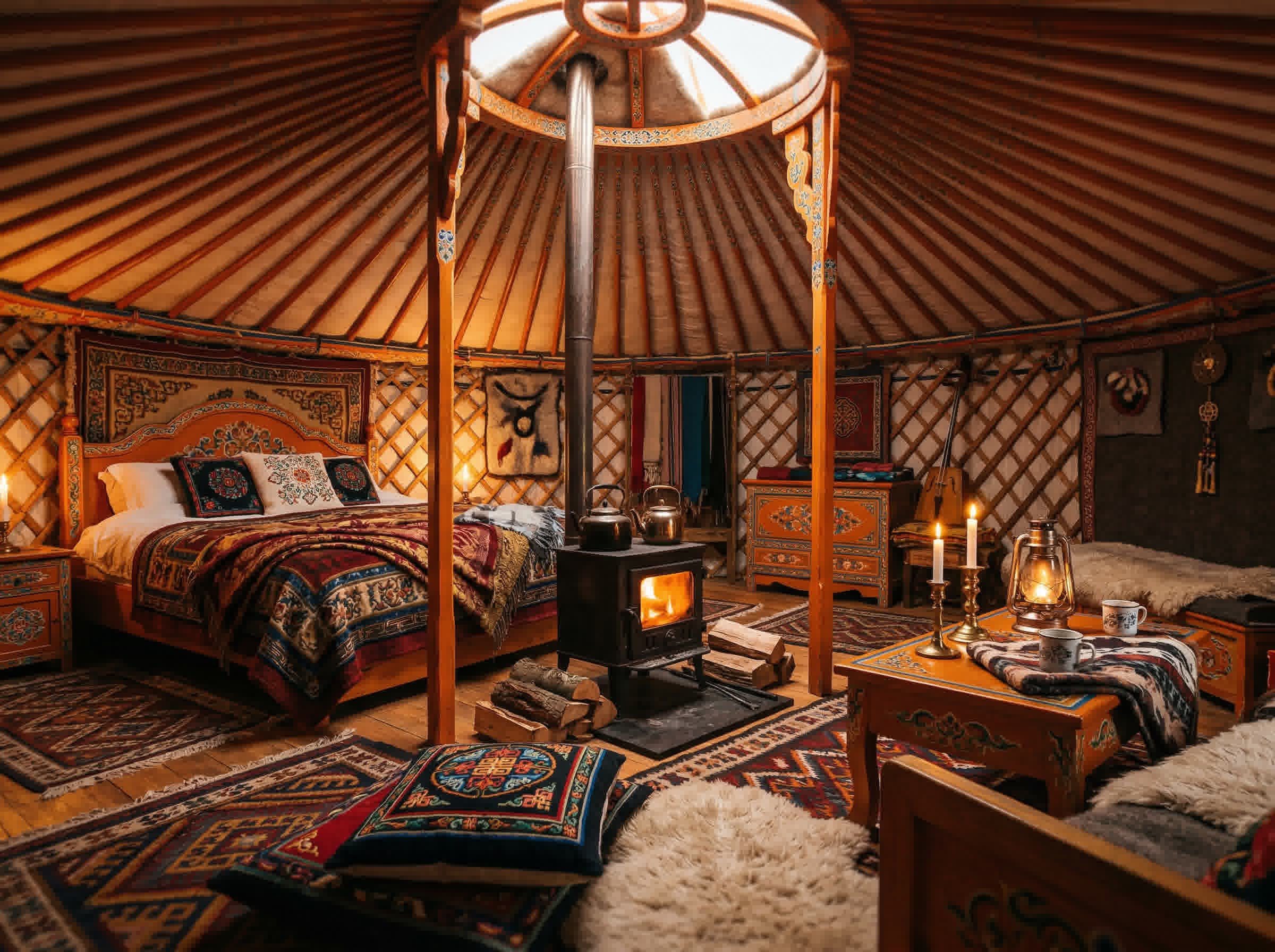
The architecture of a ger is a masterpiece of practical engineering developed over thousands of years. It can be disassembled and packed onto camels or horses in under an hour, reassembled in under two, and is designed to keep its inhabitants warm in winters that regularly hit -30°C and cool in summers that can reach 35°C. The circular shape deflects wind. The felt insulation holds heat. The central toono — the circular skylight at the top — acts as both chimney for the central stove and skylight, and is the first thing you see when you lie down to sleep.
Inside, every element has its place. The central wood or dung stove is the heart of the ger. The beds are arranged around the walls. The altar — a small shelf holding sacred objects and often a photograph of the Dalai Lama — faces the door. Furniture is typically painted orange and red with traditional patterns. Everything folds, packs, and moves.
Approximately 25–30% of Mongolia's population still lives in gers full-time, following the seasons across the steppe with their herds of horses, cattle, sheep, goats, and yaks.
Types of Ger Stay: Tourist Camp vs. Nomadic Homestay
There are two fundamentally different ways to stay in a ger in Mongolia, and understanding the difference will shape the experience you choose.
Tourist Ger Camps
Tourist ger camps are private lodges built specifically for visitors. They're found throughout the countryside — Terelj National Park (just 55 km from Ulaanbaatar), the Orkhon Valley, the Gobi Desert, and near Khuvsgul Lake all have concentrations of them.
The gers at tourist camps are typically larger than standard nomadic gers, fitted with proper beds, basic electric lighting (from a solar generator), and sometimes heating. Hot showers and flushing toilets are usually available in a separate building a short walk away. Meals are served in a central dining ger or restaurant.
Pros: Comfortable, accessible, and well-organized. Good for first-timers, families, or anyone who wants the atmosphere without roughing it entirely. Easy to book online.
Cons: The experience is staged rather than authentic. You're staying in a tourist facility that happens to be round. The cultural immersion is limited.
Cost: $30–80/night, often including meals.
Nomadic Family Homestay
This is the real thing. You stay in — or in a spare ger belonging to — an actual nomadic family living their actual life. The toilet is a hole in the ground a walk from the gers. There is no running water (hand-washing from a small portable basin is the norm). Meals are whatever the family makes: usually meat, dairy, and noodles, fresh from their own herd. The family sleeps nearby. Animals graze and wander around the camp.
What you gain in exchange for the lack of creature comforts is access to a way of life that very few outsiders ever truly enter. You'll be invited to watch or help with morning livestock herding. You'll drink airag — fermented mare's milk — from a communal bowl. You'll sit in the hazy warmth of the stove while a grandmother tells your guide about the old ways, and your guide translates in imperfect but heartfelt English. At night, the stove is stoked by different family members throughout the hours, and you fall asleep to absolute silence.
Pros: Authentic, transformative, culturally rich, and directly beneficial to the host family.
Cons: Basic facilities; requires a guide or operator who has genuine relationships with host families; not suitable for those with significant physical limitations or very strict dietary requirements.
Cost: $15–40/night with meals, usually arranged through a guide or operator like GER to GER Mongolia (who channel up to 80% of fees directly to host families).
Ger Etiquette: The Essential Rules
Ger etiquette matters. Mongolian nomads are extraordinarily forgiving of foreign ignorance — they expect you to be lost, and they will correct mistakes with warmth — but making an effort to honor the customs shows respect that is always noticed and appreciated.
Entering the Ger
- Always enter with your right foot first. Stepping with the left foot is considered bad luck.
- Never step on the threshold (the wooden beam at the base of the door). This is one of the most important rules and applies universally across Mongolia.
- Close the door behind you — leaving it open is impolite.
Moving Inside
- Go to the left when you enter. The left side is for guests; the right side is reserved for the family.
- Move clockwise inside the ger — do not walk between the central stove and the altar at the back.
- Do not point your feet toward the altar at the back of the ger, or toward the stove. When sitting or lying down, adjust your position so feet face the door.
- Do not lean on or touch the support poles (the bagana). These are structurally and spiritually significant.
- Do not stand on or handle the ropes inside the ger.
- Women should not sit at the head of the ger (the spot directly opposite the door), which is reserved for the male head of household.
Food and Drink
- Always accept what is offered. When your host passes you suutei tsai, airag, or any food, receive it with your right hand while supporting your right elbow with your left. Even if you don't want to eat or drink, touch the bowl briefly to your lips — outright refusal is disrespectful.
- When offered a bowl of airag, take a small sip and pass it back or to the next person. You don't have to drink the whole thing.
- When offered vodka, the traditional gesture is to dip your right ring finger into the cup and flick a few drops toward the sky, toward the ground, and toward the stove (honoring the sky gods, the earth, and the hearth) before drinking.
General Conduct
- Use your whole palm to point, not your finger.
- Ask before photographing family members, the interior, or animals. Most Mongolians enjoy being photographed but appreciate being asked.
- Never throw rubbish, hair, or tissue paper into the fire — the fire is sacred.
- Bring a small gift when arriving. Sweets, biscuits, candy for children, or a practical item from your home country are all appreciated. School supplies (pens, notebooks, coloring books) are beloved by families with children.
What You'll Eat and Drink
Mongolian nomadic food reflects the steppe environment: heavy on meat and dairy, light on vegetables, and utterly seasonal.
Suutei tsai (salted milk tea) is the lifeblood of the ger. You will drink many bowls of it. It is made from black tea, water, fresh milk, and salt — an acquired taste for most Westerners that becomes addictive within a day or two.
Airag (fermented mare's milk) is Mongolia's most iconic drink — mildly alcoholic, fizzy, sour, and an acquired taste of a different order. It's produced throughout summer when mares are in milk, and a ger visit in June through August will almost certainly include it.
Tsuivan (fried noodles with meat) and buuz (steamed dumplings filled with minced mutton) are the most common cooked dishes. Khorkhog — meat slow-cooked with hot stones inside a sealed pot — is a celebratory dish you may encounter on longer stays or special occasions.
Mutton is the staple meat. You'll also encounter beef, goat, horse, and camel. Vegetarians should communicate their needs clearly to their guide well in advance, as traditional nomadic cooking has limited plant-based options, though rice, noodles, and vegetables can always be provided with preparation.
The Daily Rhythm of Nomadic Life
Life in a nomadic ger moves to a schedule entirely set by animals and weather. Waking early (often before dawn) to let livestock out and check on the herd. Morning milking. Breakfast. The long middle of the day when the sun is high and work slows. Afternoon chores — herding, fetching water, repairing equipment. Evening milking. Dinner. Sleep.
If you stay more than one night, you'll start to feel this rhythm without being told it. You'll wake when the animals wake. You'll find yourself outside at dusk watching the horses come in without quite knowing why. The pace of the steppe is profoundly different from the pace of modern urban life, and most visitors describe the adjustment as something closer to relief than culture shock.
You may be invited to help with tasks: churning airag (an arm workout), collecting dried dung fuel (argal) for the fire, or herding sheep back to the night enclosure. These are invitations, not obligations, but participating changes the experience entirely.
How to Arrange a Ger Stay
Option 1: Through a guided tour. This is the most reliable approach. Your guide will have existing relationships with host families and can prepare them for your arrival, arrange meals, and handle communication. Operators like GER to GER Mongolia, Goyo Travel, and Green Clover Tour specialize in authentic nomadic stays across different regions.
Option 2: Independently while traveling by vehicle. In rural Mongolia, it's possible to approach nomadic families and ask to stay — the tradition of hospitality (zochin) is deeply ingrained, and families will rarely turn away a respectful visitor. You'll need some Mongolian phrases, a gift, and ideally a local contact or guide who can introduce you. Never assume a stay is free and always offer payment or a significant gift.
Option 3: Self-guided with a cultural operator. GER to GER Mongolia produces route maps and coordinates homestays along specific trekking routes, allowing independent travelers to move between host families with structure and with payments going directly to families.
Where to stay: The Orkhon Valley (central Mongolia), Terelj National Park (closest to UB), and the Khuvsgul Lake region (north) are the most accessible areas for nomadic stays. More remote options include the Gobi Desert, western Mongolia, and Khentii province.
Why This Is the Most Transformative Experience in Mongolia
Travel has a way of returning to particular moments. Years after a trip, you remember not the museum you visited or the restaurant meal, but the moment of genuine human contact — the grandmother who pressed your hand and smiled without any shared language, the child who showed you her lamb, the herder who pointed to the stars and named them.
A ger stay in Mongolia produces these moments in abundance. Not because Mongolians perform hospitality for tourists, but because hospitality is simply how they live. Zochin — the guest — is a sacred concept in nomadic culture. You are welcomed not because you paid for it but because welcoming people is right.
You will leave a ger stay having learned something about generosity, simplicity, and the relationship between humans and landscape that no amount of reading can teach. And you'll find yourself, months later, thinking about the view through the toono, the sound of the stove, and the particular quality of silence just before dawn on the steppe.
That's what a ger stay in Mongolia does.
Planning a trip that includes an authentic nomadic stay? Unveil Mongolia crafts travel experiences that connect you with real Mongolian families across the steppe, the Orkhon Valley, and the Khuvsgul region — always with respect for local culture and direct benefit to host communities. Toilogt Resort on Khuvsgul Lake offers ger accommodation as well as visits with the nomadic families of the north. Get in touch to start planning your stay.