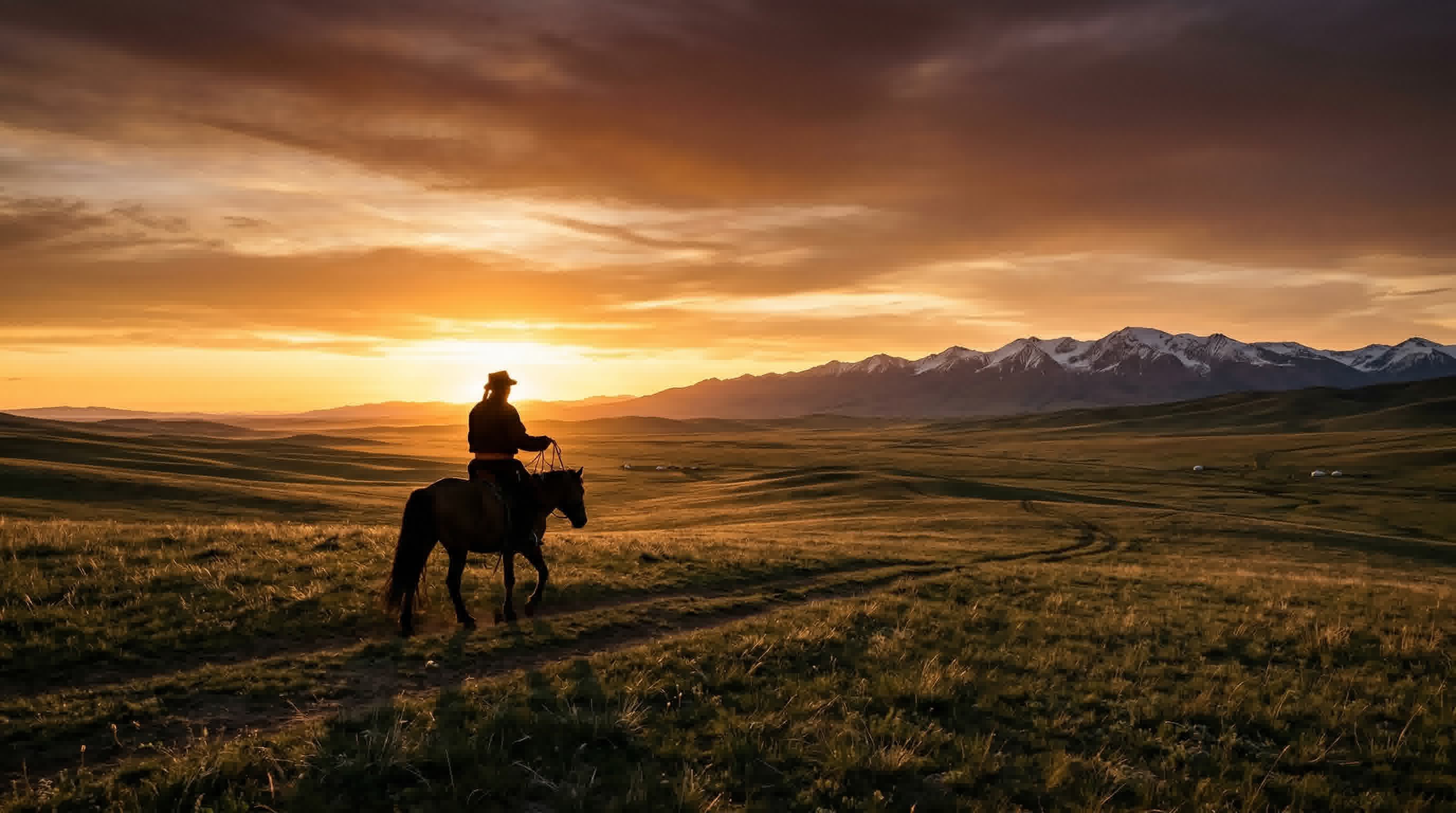
Stand outside a Mongolian ger on a clear winter night. The felt walls glow orange from the stove burning inside. Above you, the sky is so thick with stars that you feel the weight of the universe leaning down. The toono — the circular crown opening at the top of the ger — frames a perfect circle of sky like a portal, and smoke drifts through it like an offering. For Mongolians, this is not poetry. It is physics, cosmology, and home — all at once. The Mongolian ger is one of humanity's most sophisticated portable dwellings, refined over at least 4,000 years of nomadic life on the Central Asian steppe. It withstands temperatures of -40°C in winter and stays cool in summer heat. It can be assembled by a family in under an hour and loaded onto two camels or a small truck for migration. It is also, in every detail of its structure and interior arrangement, a miniature model of the universe. If you are visiting Mongolia — staying at a ger camp, visiting a nomadic family, or simply trying to understand the culture — spending time understanding the ger unlocks everything.
What Is a Ger? (And Why Not a "Yurt"?)
The word yurt comes from the Turkic languages of Central Asia and is widely used in English to describe both Mongolian and Central Asian portable dwellings. In Mongolia, the correct word is ger (pronounced like "gare," rhyming with "air") — and using it demonstrates cultural respect. The Mongolian ger and the Central Asian yurt are related but distinct structures. Both are circular, portable, and built from a wooden lattice frame covered with felt. But a ger has a flatter, lower roof supported by two internal columns, while a Turkic yurt typically has a higher, more pointed dome without internal supports. The design difference reflects different climate conditions: Mongolia's steppe rarely sees the heavy snowfall loads common in Central Asian mountains, so a wider, lower profile works better — it is more stable in high winds and encloses more usable floor space per unit of weight. For thousands of years, the ger has been the primary dwelling of Mongolian nomads. It appears in rock paintings on Mandal Mountain in Inner Mongolia dating back approximately 4,000 years. It sheltered the armies of Genghis Khan and his successors as they built the largest contiguous land empire in history. And today, roughly 30 percent of Mongolians still live in gers — both on the steppe and in the sprawling ger districts that ring Ulaanbaatar.
The Structure of a Mongolian Ger
The ger is a masterpiece of functional engineering. Every component has a name, a purpose, and in many cases a spiritual significance.
The Khana — Lattice Walls
The walls of the ger are formed from khana — expandable wooden lattice panels made from thin poles of willow or poplar, crossed and lashed together with leather straps (traditionally camel hide, which is both strong and flexible). When folded for transport, a single khana section is compact. When unfolded, it expands into a section of circular wall. The number of khana sections determines the size of the ger. A standard family ger uses four to six sections, creating a floor diameter of roughly 5 to 7 meters. The rhombus pattern of the khana lattice is not just structural — it symbolically represents the rolling hills of the steppe, a reminder that the walls of the home echo the landscape surrounding it.
The Uni — Roof Poles
The uni are the roof poles that radiate outward from the crown ring like the spokes of a wheel, slotting into the tops of the khana walls at their lower ends. A standard 5-wall ger uses 81 uni poles — 81 being nine times nine, and nine being an auspicious number in Mongolian culture. Larger ceremonial gers may use 108 poles, a sacred number in Tibetan Buddhism. The upper ends of the uni are often painted and decorated with traditional Mongolian patterns, including arrow-feather motifs that are visible from inside when you look up toward the toono.
The Toono — Crown Ring
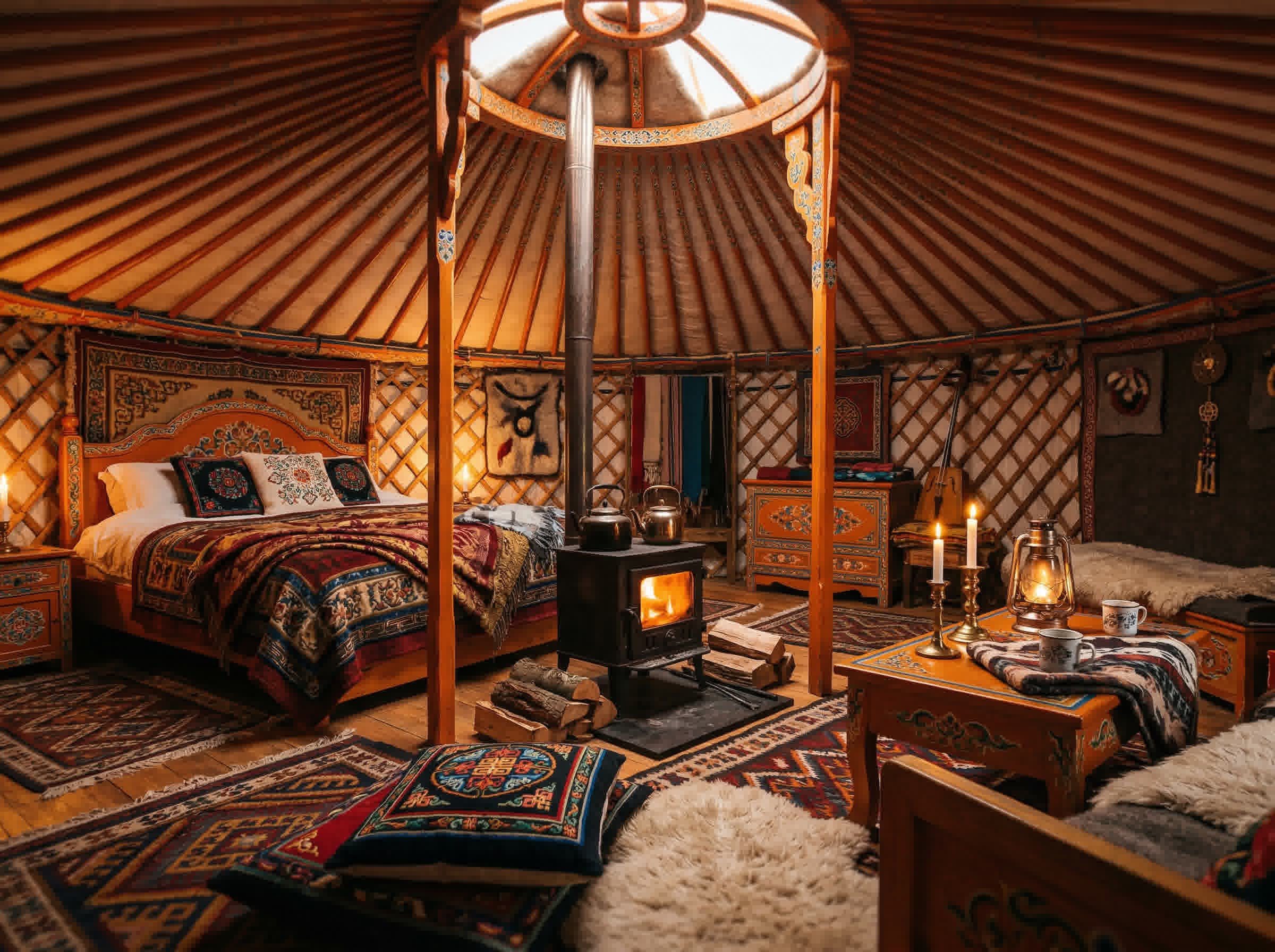
The toono is the circular crown at the apex of the ger's roof — and it is perhaps the most symbolically important element of the entire structure. It is the ger's window, smoke vent, natural sundial, and cosmic portal. During daylight hours, a shaft of sunlight enters through the toono and moves across the interior like the hand of a clock, allowing experienced inhabitants to track the time with precision. This is one of the reasons Mongolian traditional timekeeping was so accurate long before mechanical clocks arrived. The toono is covered by a felt flap (orh) that can be adjusted by pulling a rope — opened to admit light and ventilate smoke, closed against rain or cold. The toono opening represents the sky and the sun — the connection between the domestic world inside the ger and the infinite universe above. When someone dies in a ger, the toono is opened fully, allowing the spirit to depart upward.
The Bagana — Support Pillars
Two vertical wooden columns called bagana support the toono from below. They stand slightly south of center, flanking the stove, and they carry both the structural weight of the roof and deep symbolic significance. The two columns are understood to represent husband and wife — the dual pillars of the family. It is strictly forbidden to step between them, to lean against them casually, or to pass objects between people across them. Violating these prohibitions is considered deeply disrespectful.
The Door
The door (haalga) of a Mongolian ger always faces south — toward the sun, and away from the prevailing north wind. This orientation is not merely practical; it is cosmological, connecting the ger to the cardinal directions and the movement of the sun across the sky. The door frame is low — traditionally requiring visitors to bow their heads on entry, an act of humility. The door itself is often elaborately painted in orange (representing the sun and fire) or blue (the color of the eternal sky, the most sacred color in Mongolian culture). Never step on the threshold when entering a ger. This is a firm social rule — the threshold has spiritual significance, and stepping on it is considered an insult to the family.
The Felt Layers
The structural frame is covered in multiple layers of sheep's wool felt — the most remarkable insulating material in the nomadic toolkit. In winter, a ger uses two or three layers of thick felt, capable of maintaining interior temperatures well above freezing even when it is -40°C outside. In summer, the felt can be partially rolled up to admit cool air. A waterproof canvas outer cover protects the felt from rain. The manufacturing of felt is itself a craft — sheep's wool is cleaned, layered, wetted, and rolled underfoot (sometimes with horses walking over large felt mats) until the fibers bind. A complete set of ger felt requires the wool of approximately 150 sheep.
How a Ger Is Assembled
A Mongolian family can erect a complete ger in 30 to 60 minutes. The process follows a precise sequence:
- Mark the center of the ger's position and place the stove base.
- Unfold and connect the khana sections in a circle around the center, lashing the ends together with rope.
- Set the bagana (support columns) upright at the designated spots, resting the toono on top.
- Insert the uni (roof poles), slotting them into the toono at the top and the tops of the khana at the bottom.
- Lay the inner felt liner over the khana and uni, beginning from the door.
- Add the insulating felt layers — first the roof sections, then the wall sections, carefully overlapped.
- Apply the waterproof canvas cover over the felt.
- Secure everything with long ropes passed over the roof and tied at the base of the walls.
- Set the door in place.
The entire structure is self-supporting — held together by the tension between the outward-pushing walls and the compressive force of the roof ring. No nails, no bolts, no foundation. When migration comes, the process reverses in similar time.
Interior Layout: A Universe in Miniature
The interior of a Mongolian ger is not random. Every object, every person, every activity has a prescribed position — a spatial grammar that reflects Mongolian cosmology, social hierarchy, and the practical realities of nomadic life.
The Stove — Center of the Universe
At the center of the ger sits the tulga — the iron stove. It is the heart of the home: the source of heat, the place of cooking, the spiritual center of the family. The fire inside is sacred. You must never throw garbage into it, point your feet toward it, or step over it. In some traditions, offerings of butter or the first sip of any drink are given to the fire. The stove is positioned directly under the toono so that smoke can escape. The alignment of stove, toono, and sky creates a vertical axis — an axis mundi — connecting the domestic world to the cosmos.
The North Wall — Sacred Space
The north wall, directly opposite the door, is the most sacred part of the ger. This is where the burkhan (altar) sits — a shelf displaying Buddhist icons, photographs of ancestors, a butter lamp, and other sacred objects. It is the space reserved for honored guests, elders, and the spiritual life of the family. Modern gers often add a television or radio to this wall (positioned pragmatically near the altar), but the altar always remains. When you visit a Mongolian ger, move toward the north wall as directed by your host — it is a sign of welcome and respect.
The West Side — Men's Domain
The left side of the ger as you face north (the west, as you enter facing south) is the men's side. Saddles, bridles, hunting gear, tools, and the bed of the head of household are typically found here. Male guests are invited to sit on the west side.
The East Side — Women's Domain
The right side of the ger (the east) is the women's side. Kitchen equipment, dairy-making tools, the family's food stores, and the bed of the wife are found here. Female guests sit on the east side. The division is practical as much as symbolic — it keeps tools and equipment organized in a small space.
Bed Arrangements
Beds in traditional gers are low platform beds or thick mattresses placed against the side walls. The senior couple of the household sleeps on the north side (closest to the altar). Children and younger family members sleep toward the south, closer to the door. Guests may be offered a bed near the altar if the hosts consider them particularly honored.
The Ger as Microcosm of the Universe
Every element of the ger is understood by Mongolians as reflecting a greater cosmic order. The circular floor plan represents the infinite circle of the universe. The roof is the sky. The toono is the sun and the portal to the world above. The stove is the five elements: earth, wood, fire, metal, and water. The two bagana columns represent the polarity of husband and wife, of masculine and feminine, of the foundations on which family life rests. This cosmological understanding is not merely philosophical — it shapes daily behavior. The way you move through the ger, where you sit, what direction your feet point, how you handle the fire, whether you whistle (never, indoors — it summons bad spirits) — all of this is governed by an understanding of the ger as a sacred space, not just a shelter. Traditional Mongolian herders know exactly where the sun will cast its light through the toono at any hour of the day. They know which direction to open the door flap for ventilation depending on the wind direction. They know how to adjust the felt layers for maximum warmth. This is not superstition — it is a deeply sophisticated environmental knowledge embedded in cultural practice.
Modern Adaptations: Solar Panels and Satellite Dishes
The traditional ger has proven remarkably adaptable to modern technology. Today, solar panels are mounted on the ger roof to power lights, phones, and televisions. Small generators supplement power in winter months. Satellite dishes are nearly universal even in remote areas, bringing national news and entertainment to gers hundreds of kilometers from the nearest city. Inside, the cast-iron stove has largely replaced the traditional open hearth, and modern Mongolian households use the same cookware and appliances as any urban family — kettles, rice cookers, gas burners when fuel is available. The ger districts of Ulaanbaatar present a fascinating fusion: thousands of gers fitted with district heating connections, paved pathways between them, and Wi-Fi antennae — a city within a city, where the ancient form of the circular felt home meets the urban infrastructure of a 21st-century capital. Yet amid all these adaptations, the fundamental structure — khana, uni, toono, bagana — and the interior spatial grammar remain intact. The altar still faces north. You still step over the threshold with care. The fire is still not for garbage.
Staying in a Ger: What to Expect
Ger camps across Mongolia offer travelers the experience of sleeping in traditional gers, ranging from simple nomadic homestays to luxurious appointments with en-suite bathrooms, heated floors, and fine linens. At Toilogt Resort on Lake Khuvsgul, for example, 15 traditional standard gers and a luxury lodge offer different levels of immersion — from authentic felt and wood-burning stove to premium comfort with lake views. The structure of the ger is the same whether you are in a herder's camp or a luxury resort; what changes is the finish. A few practical things to know when staying in a traditional ger:
- Dress for temperature swings: Gers are warm when the stove is burning but cool quickly when it goes out at night. Keep warm layers accessible.
- The toono opens for ventilation: If you wake and the ger feels stuffy, the felt cover can be adjusted.
- Respect the spatial rules: Move clockwise around the interior, keep the north wall space clear, and never lean against the support pillars.
- Mind the door threshold: Step over, not on.
A Dwelling for All Time
The Mongolian ger has sheltered humanity across 4,000 years of history — from the earliest Bronze Age herders to the vast armies of the Mongol Empire to the families who wake before sunrise today to light their stoves and call their horses home. Its elegance lies in the fact that it solves every problem at once: warmth, portability, spatial organization, structural integrity, and a profound sense of orientation within the universe. When you sleep in a ger and look up through the toono at the circle of stars above, you are not experiencing a novelty. You are experiencing one of humanity's oldest and most enduring answers to the question of how to live.
*Ready to experience the Mongolian ger firsthand? Unveil Mongolia's tours offer authentic ger stays — from nomadic family homestays in Central Mongolia to the comfort of Toilogt Resort on Khuvsgul Lake, where 15 traditional gers sit at the edge of one of Asia's most spectacular lakes. **Discover our packages at *unveilmongolia.com.