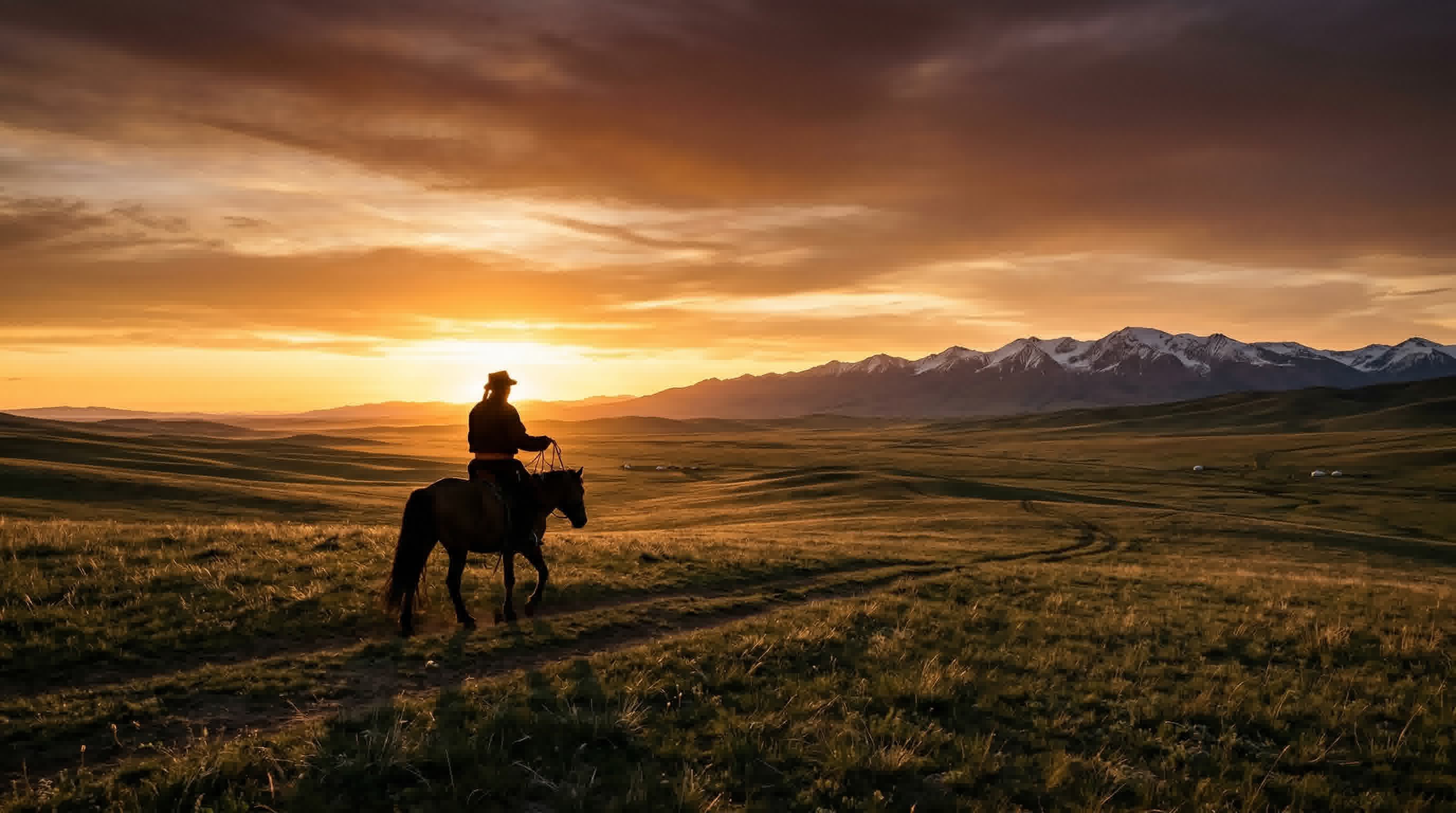
There is a moment, somewhere out on the Mongolian steppe, when the silence hits you. No traffic. No notifications. Just the wind moving through tall grass, the smell of smoke drifting from a ger, and the distant sound of a child calling horses home. In that moment, you understand something that no documentary can fully convey: nomadic life in Mongolia is not a relic. It is not a performance for tourists. It is a living, breathing civilization that has endured for thousands of years — and it is happening right now, in the same valleys and under the same open sky that Genghis Khan's generals once crossed. Roughly 25 to 30 percent of Mongolia's 3.4 million people still live as nomadic herders, moving with their animals through the seasons. If you are traveling to Mongolia — or simply trying to understand one of the world's last great nomadic cultures — this guide is for you.
The Rhythm of the Year: Four Migrations
The defining feature of nomadic life in Mongolia is movement. A herding family does not simply plant roots and stay. They follow the land, the water, the grass, and the cold — shifting camp at least four times a year to seasonal pastures that have been used by their families for generations.
- Winter camp (November–March): Families move to sheltered spots, often in front of a mountain or tucked into a valley, to escape the brutal winds. Temperatures can plunge to -40°C or lower. The ger is insulated with extra layers of felt, and livestock are brought into wooden pens at night.
- Spring camp (April–May): As the snow melts, families move closer to rivers and lower plains where the first grass pushes through. This is a time of birth — lambs, foals, and calves arrive, and the work of the year truly begins.
- Summer camp (June–August): The richest season. Families move to higher ground or riverside pastures flush with grass. Mares are milked daily to make airag (fermented horse milk), dairy products are produced in abundance, and the Naadam festival brings communities together for celebration.
- Autumn camp (September–October): A final move, often uphill, to collect hay and fatten livestock before the long freeze. Animals are selected for winter slaughter, and families begin preparing for the cold months ahead. Most families move to the same seasonal spots year after year. The circular imprint a ger leaves on the ground is recognized as a kind of claim — out of deep respect, no other family would set up camp on a recently vacated site.
The Five Snouts: Livestock as Life Itself
In Mongolia, wealth is measured not in currency but in animals. The five types of livestock — known collectively as tavan khoshuu mal, or "the five snouts" — are the foundation of nomadic existence. They are horse, cow (and yak in mountain regions), sheep, goat, and Bactrian camel.
Horses are the soul of the steppe. Every Mongolian herder rides from childhood, and horses are used for herding, transportation, and producing airag. The Mongolian horse is a compact, hardy breed that survives harsh winters by digging through snow with its hooves to find grass.
Sheep are the most economically important animal — providing meat, wool for felt, and milk. A family with 200 to 500 sheep is considered comfortably middle class.
Goats are valued for their cashmere, combed by hand each spring. Mongolia is one of the world's largest cashmere producers, and the cashmere industry has transformed many nomadic livelihoods — though it has also led to overgrazing, since goats are harder on pasture than sheep.
Cattle and yaks provide milk, meat, and labor. In the mountainous west, yaks dominate; on the open steppe, cattle are more common.
Bactrian camels are the freight carriers of the desert and semi-arid regions. Once essential for migration — capable of carrying an entire ger's contents — camels are now increasingly rare, with camel caravans giving way to trucks and motorcycles.
A family's herd is everything. Losing animals to a harsh winter is not just financial ruin — it is cultural devastation.
Daily Life Inside a Nomadic Family
Dawn in a nomadic ger begins before sunrise. The first task is lighting the stove — a cast-iron burner that sits at the center of the ger, fed by dried dung (argal), wood, or coal. The mother boils water for suutei tsai, the salty milk tea that anchors every Mongolian morning.
By the time the tea is poured, the men and older children are already outside. Horses must be gathered from where they grazed overnight, goats and sheep counted, and the milking begun. The morning routine is a carefully choreographed rhythm that has changed very little over centuries.
The women of a nomadic household manage an extraordinary range of tasks: milking livestock, making dairy products (yogurt, dried curds, fresh cheese), sewing and repairing felt, cooking, and managing the household economy. Men handle the herding, animal health, equipment repair, and the demanding physical labor of migration.
Children earn their place early. By age five or six, Mongolian children are riding horses and helping with simple herding tasks. By ten, many can manage a small herd independently. The children of nomads grow up with a practical intelligence — reading weather, tracking animals, navigating vast distances — that no classroom can replicate.
Evenings are communal. Families gather inside the ger, drinking tea, eating a dinner of boiled mutton or noodle soup, and talking. Television (powered by solar panels or small generators) is increasingly common, but the traditional structure of family life remains largely intact.
Setting Up and Taking Down a Ger
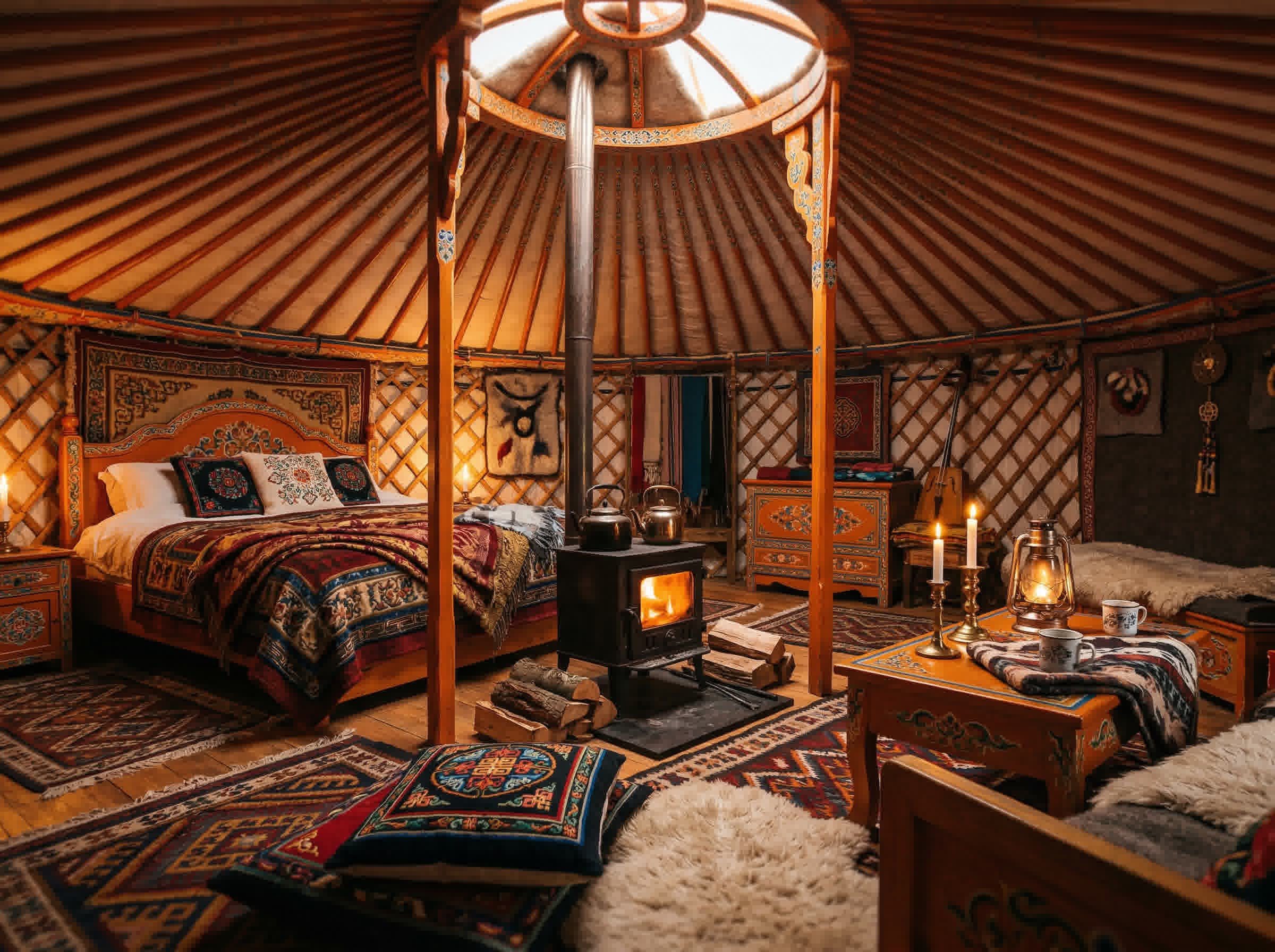
The Mongolian ger is one of humanity's most elegant engineering achievements. It can be assembled by a family of four in under an hour, disassembled in about the same time, and loaded onto two or three camels or a small truck. It withstands winds of over 100 km/h, stays warm in temperatures of -40°C, and keeps cool during summer heat.
The construction follows a precise sequence. The lattice walls (khana) are unfolded first and arranged in a circle. The two central support pillars (bagana) are set, then the roof ring (toono) is raised and the roof poles (uni) are slotted in — each pole connecting the toono to the top of the khana. Layers of felt are then wrapped around the outside, followed by a waterproof canvas cover.
The door always faces south — toward the sun, and away from the prevailing north wind. This is not merely practical: it is cosmological. The orientation of the ger is deeply tied to Mongolian beliefs about the universe, the relationship between humans and the sky, and the proper order of things.
Modern Challenges: Urbanization, Climate, and the Pull of the City
Nomadic life in Mongolia is under pressure from multiple directions, and being honest about those pressures is part of understanding what makes experiencing it so meaningful today.
Dzud: When Winter Becomes a Killer
The dzud — Mongolia's catastrophic winter disaster — has always been part of nomadic life. But it is becoming more frequent and more devastating. A dzud occurs when summer drought leaves pastures depleted, followed by extreme cold and heavy snowfall that buries the remaining grass under ice. Starved and weakened, livestock die by the millions.
In the 2023–2024 winter alone, 8.1 million animals perished — a loss rate of 12.6 percent of the national herd, recalling the worst dzud on record in 2009–2010. According to Yale E360, dzuds are projected to strike up to 20 percent more often by 2080 as climate change weakens the polar jet stream and intensifies extreme weather across Central Asia. Mongolia has already warmed by more than 2°C since 1940 — three times the global average.
For herders, a severe dzud does not just mean financial loss. It means the complete collapse of a family's livelihood, forcing migration to the city.
The Pull of Ulaanbaatar
Mongolia is urbanizing at one of the fastest rates in Asia. Ulaanbaatar, home to roughly half the country's population, now rings with a vast ger district — hundreds of thousands of families who have left the countryside but brought their portable homes with them, erecting them on city hillsides without running water or central heating.
Young people, in particular, are drawn to the capital by education and opportunity. For many, the choice feels impossible: stay on the steppe and face climate precarity, or leave for the city and lose the language of animals and seasons that their grandparents knew.
And yet: the pull of the steppe is real. Many young Mongolians who move to the city describe an ache for open space, for the smell of the land, for the particular freedom of riding a horse before sunrise. Nomadic identity runs deep.
Why Nomadic Culture Is Still Very Much Alive
Despite these challenges, nomadic culture in Mongolia is not dying quietly. It is adapting.
Solar panels now power televisions and phones in remote gers. Motorcycles have replaced horses for long-distance herding. Satellite dishes bring news from Ulaanbaatar to the most remote valleys. Some herder families sell cashmere directly to international buyers via smartphone.
The Mongolian government has recognized traditional nomadic herding as a national cultural heritage. UNESCO inscribed the traditional technique of making airag in the khokhuur on its Representative List of Intangible Cultural Heritage. Naadam — the summer festival of horsemanship, archery, and wrestling — draws both locals and international visitors in a celebration of everything nomadic culture represents.
Most powerfully, nomadic life persists because it works. The steppe cannot support cities. It can support millions of animals, carefully managed by families who read the land with generations of inherited knowledge. The nomadic system — flexible, low-impact, deeply adapted to Mongolia's extreme environment — is not primitive. It is sophisticated.
How Travelers Can Respectfully Experience Nomadic Life
Visiting a nomadic family is one of the most profound travel experiences on earth — and getting it right matters.
Do:
- Accept every offer of food and drink. Refusing suutei tsai (milk tea) or airag from a host family is considered rude. You don't have to finish everything — even a sip and a nod of appreciation is enough.
- Enter the ger by stepping over (never on) the threshold.
- Move to the right (west) side if you are a man, left (east) if you are a woman.
- Ask before photographing people or their livestock.
- Bring a small gift — sugar, flour, sweets for children, or vodka for the adults — as a gesture of respect.
Don't:
- Lean against the ger's support poles — they carry spiritual significance.
- Walk between the two central pillars.
- Point your feet toward the altar (north wall) or the stove.
- Whistle inside the ger — it is considered bad luck.
The best way to experience nomadic life responsibly is through an operator who has genuine relationships with herder families — not a staged performance, but a real homestay where you share daily life, help with chores, and experience the rhythms of the steppe on their terms.
A Final Note: Why This Matters Now
There is something urgent about visiting a culture that is genuinely in transition. Nomadic life in Mongolia is not going away — but it is changing, faster than at any point in history. The families who still migrate four times a year, still make airag in leather sacks, still raise children who can name the moods of horses — they are not living in the past. They are choosing a way of life, often against considerable odds.
Traveling to Mongolia to experience this is not voyeurism. Done with respect and curiosity, it is a form of witness — and a way of understanding that there are many different answers to the question of how a human life can be lived.
*Planning your Mongolia adventure? Unveil Mongolia offers curated tours that include authentic nomadic family homestays — real gers, real families, real steppe life. Our Central Mongolia Heritage Trail and Khuvsgul tours are designed to connect you with the heart of nomadic culture in a way that is respectful, immersive, and unforgettable. **Explore our tours at *unveilmongolia.com.